
Anyone who has ever tried to book a puja, plan a trip home, or send a gift on time knows the small panic of asking, "wait, when is Diwali this year?" The dates move every year, and in 2026 they move more than usual. This is your complete Hindu festival calendar 2026, with the verified date for every major celebration and the meaning behind it.
Keep this page bookmarked. Below you will find a clean month-by-month table you can scan in seconds. After it comes the story of each festival, a vrat calendar of the fasting days that repeat through the year, and the reason the dates shift at all.
Key takeaways
- Diwali 2026 falls on Sunday, 8 November, with Dhanteras on 6 November and Bhai Dooj on 11 November.
- The big festive run is late August to mid-November: Raksha Bandhan (28 Aug), Janmashtami (4 Sep), Ganesh Chaturthi (14 Sep), Navratri (11 Oct), Dussehra (20 Oct) and Diwali (8 Nov).
- Most festivals land later in 2026 than in 2025 because this year carries an extra lunar month (Adhik Maas), which stretches the Hindu calendar.
- Hindu festival dates follow the tithi, the lunar day, not a fixed calendar date, so they shift a little every year.
- Alongside the big festivals, monthly vrat days like Ekadashi, Purnima and Amavasya give the year its quieter, steady rhythm.
Why Hindu festival dates change every year
Hindu festivals follow the moon, not the fixed English calendar, so each one lands on a different date every year. A festival is tied to a tithi, a lunar day, rather than to, say, the 8th of November.
The Hindu calendar is lunisolar. It tracks the moon's phases for months and tithis. Then it adjusts to the sun, so the seasons stay in place. A lunar year runs about 11 days shorter than a solar year. So a festival usually creeps earlier each year.
To stop the calendar from drifting out of season, an extra lunar month is added roughly every three years. It is called Adhik Maas, or Malmaas. The year 2026 carries one of these extra months, so instead of arriving earlier, most festivals this year fall noticeably later than they did in 2025.
That is why Diwali sits in early November in 2026 rather than late October. One more thing helps. North and South India count the lunar month differently, called Purnimanta and Amanta. So a few festivals fall a day apart between regions. With the "why" settled, here is the full year at a glance.
The Hindu festival calendar 2026, month by month
Here is the complete Hindu festival calendar 2026 in one table, with the date, weekday and a one-line note on what each day marks. Dates follow the Drik Panchang reckoning for New Delhi and may vary by a day in some regions.
| Date (2026) | Festival | What it marks |
|---|---|---|
| Wed, 14 Jan | Makar Sankranti / Pongal | Sun enters Capricorn; harvest and the turn towards longer days |
| Fri, 23 Jan | Vasant Panchami | Saraswati Puja; the first day of spring and of learning |
| Sun, 15 Feb | Maha Shivratri | The great night of Lord Shiva; fasting and night-long worship |
| Tue, 3 Mar | Holika Dahan | The bonfire on the eve of Holi; the burning away of evil |
| Wed, 4 Mar | Holi | The festival of colours; spring and the win of good over evil |
| Thu, 19 Mar | Chaitra Navratri begins | Nine nights of the Goddess; also Ugadi and Gudi Padwa |
| Thu, 26 Mar | Ram Navami | The birth of Lord Rama, on the ninth day of Chaitra Navratri |
| Thu, 2 Apr | Hanuman Jayanti | The birth of Lord Hanuman, the deity of strength and devotion |
| Tue, 14 Apr | Baisakhi / Mesha Sankranti | Solar new year and harvest in the north |
| Sun, 19 Apr | Akshaya Tritiya | An auspicious day for buying gold and starting ventures |
| Wed, 29 Jul | Guru Purnima | A day to honour teachers and spiritual guides |
| Sat, 15 Aug | Hariyali Teej | A monsoon festival for married women, sacred to Parvati |
| Mon, 17 Aug | Nag Panchami | Worship of the serpent deities |
| Wed, 26 Aug | Onam (Thiruvonam) | Kerala's harvest festival welcoming King Mahabali |
| Fri, 28 Aug | Raksha Bandhan | The bond between brothers and sisters; tying of the rakhi |
| Fri, 4 Sep | Krishna Janmashtami | The birth of Lord Krishna; midnight fasting and celebration |
| Mon, 14 Sep | Ganesh Chaturthi | The arrival of Lord Ganesha into homes and pandals |
| Sun, 11 Oct | Sharad Navratri begins | Nine nights of Durga; garba, golu and daily fasting |
| Mon, 19 Oct | Durga Ashtami and Maha Navami | The most powerful days of Navratri worship |
| Tue, 20 Oct | Dussehra (Vijayadashami) | The victory of Rama over Ravana; good over evil |
| Sun, 25 Oct | Sharad Purnima | The harvest full moon; offerings of kheer under moonlight |
| Thu, 29 Oct | Karva Chauth | A day-long fast by wives for their husbands' long life |
| Sun, 1 Nov | Ahoi Ashtami | Mothers fast for their sons' well-being and long life |
| Fri, 6 Nov | Dhanteras | The start of Diwali; buying silver, metal and Lakshmi worship |
| Sat, 7 Nov | Naraka Chaturdashi (Choti Diwali) | The small Diwali; the eve of the main festival |
| Sun, 8 Nov | Diwali (Lakshmi Puja) | The festival of lights; worship of Lakshmi and Ganesha |
| Tue, 10 Nov | Govardhan Puja | Gratitude to nature, marking Krishna lifting Govardhan hill |
| Wed, 11 Nov | Bhai Dooj | A second day for the brother and sister bond |
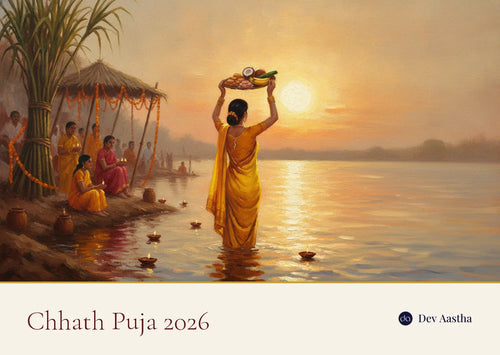
| Sun, 15 Nov | Chhath Puja | Worship of the Sun god, mainly in Bihar and the east |
| Fri, 20 Nov | Dev Uthani Ekadashi | Vishnu wakes from his four-month cosmic sleep; the wedding season reopens |
| Sat, 21 Nov | Tulsi Vivah | The ceremonial marriage of the tulsi plant to Vishnu |
| Tue, 24 Nov | Kartik Purnima / Dev Diwali | The gods' Diwali; lamps on the ghats of Varanasi |
| Sun, 20 Dec | Gita Jayanti | The day the Bhagavad Gita was spoken to Arjuna |
That table is the quick answer. The sections below walk through the same year season by season, so you know not just when each festival falls but why it matters and how families mark it.
Spring festivals: January to April
The year opens with harvest and light, moves through spring colour, and closes its first quarter with the births of Rama and Hanuman. These months set a hopeful, outward-looking tone before the summer lull.
Makar Sankranti and Pongal (14 January)
Makar Sankranti is one of the few festivals fixed to the sun rather than the moon, which is why it lands on almost the same date each year. It marks the sun's move into Capricorn and the start of longer days. Kite flying in Gujarat, til-gud sweets in Maharashtra and the four-day Pongal in Tamil Nadu all belong to this moment.
Vasant Panchami (23 January)
Vasant Panchami welcomes spring and honours Goddess Saraswati, the deity of knowledge and the arts. Families dress in yellow, place books and instruments before her, and often begin a child's first lessons. It is a gentle, studious festival, a favourite in homes with young learners. Our Vasant Panchami Saraswati puja vidhi covers the full ritual and date.
Maha Shivratri (15 February)
The great night of Shiva is kept with fasting and night-long worship. Devotees offer water, milk and bel leaves to the Shivling. Many stay awake through all four watches of the night. It is one of the most widely kept vrats in the country, cutting across region and age.
Holi (4 March)
Holi is preceded by Holika Dahan on the evening of 3 March, a bonfire that stands for burning away negativity. The next day is the riot of colour everyone knows: gulal, water, sweets and open doors. Behind the fun sits a simple theme, the triumph of good over evil and the arrival of spring.
Chaitra Navratri and Ram Navami (19 to 26 March)
Chaitra Navratri opens the spring cycle of the Goddess and coincides with Ugadi and Gudi Padwa, the new year in the Deccan and Maharashtra. The nine nights end with Ram Navami on 26 March, the birth of Lord Rama. Many families read the Ramayana and keep a fast until noon.
Hanuman Jayanti and Akshaya Tritiya (April)
Hanuman Jayanti on 2 April celebrates the birth of Hanuman, the deity of strength, courage and pure devotion. Later in the month, Akshaya Tritiya on 19 April is considered one of the luckiest days of the year. Its name means "never diminishing". That is why people choose it for buying gold, starting a business, or a wedding. With April done, the calendar quietens until the monsoon.
Monsoon festivals: July and August
After a quiet early summer, the rains bring back the celebrations, building towards Raksha Bandhan at the end of August. These are warm, family-centred festivals rather than grand public ones.
Guru Purnima (29 July)
Guru Purnima is a full-moon day set aside to thank teachers and spiritual guides. Students visit their gurus, and many people mark it quietly at home with gratitude for those who have taught them. It is a reminder that knowledge passes from person to person, not just from books.
Hariyali Teej and Nag Panchami (15 and 17 August)
Hariyali Teej is a monsoon festival for married women, honouring the union of Shiva and Parvati with green sarees, swings and songs. Two days later, Nag Panchami honours the serpent deities, with milk and prayers offered for protection and good rains.
Raksha Bandhan (28 August)
Raksha Bandhan celebrates the bond between brothers and sisters. A sister ties a rakhi on her brother's wrist. He promises his protection and often gives a gift in return. In 2026 it falls late, on 28 August, a good few weeks after its usual early-August slot, thanks to the extra lunar month. Its close cousin Onam is celebrated in Kerala on 26 August. If you are choosing a present, see our meaningful rakhi gift ideas for brothers and sisters.
The festive peak: September to November
This is the heart of the Hindu festival calendar 2026, an almost unbroken run from Janmashtami through to Diwali and Bhai Dooj. If there is a season to plan gifts, travel and puja in advance, it is this one.
Krishna Janmashtami (4 September)
Janmashtami marks the birth of Lord Krishna at midnight. Devotees fast through the day, decorate a cradle for the infant Krishna, and break the fast at the stroke of twelve. In homes with a Laddu Gopal, the little Krishna is bathed, dressed and rocked to sleep with great tenderness.
If you are setting up the jhula and mandir at home, our Janmashtami decoration ideas for the jhula and Laddu Gopal cover the cradle, the shringar and the small touches that make the midnight aarti feel complete.
Hartalika Teej (14 September)
Hartalika Teej falls on Bhadrapada Shukla Tritiya, and in 2026 the udaya tithi places it on 14 September, the same day as Ganesh Chaturthi, though many families in Uttar Pradesh and Bihar keep it on 13 September. It is the strictest of the three Teej vrats, a nirjala fast kept by married women for their husband's long life and by unmarried girls praying for a good match. Our Hartalika Teej vrat vidhi and significance guide explains the fasting rules, the puja steps and the regional date split.
Ganesh Chaturthi (14 September)
Ganesh Chaturthi welcomes Lord Ganesha, the remover of obstacles, into homes and public pandals. Clay idols are installed, worshipped for one to ten days, and then carried in joyful processions for visarjan. It is the loudest, most public start to the festive season, especially in Maharashtra.
If you plan to install Ganesha at home, our step-by-step Ganesh Chaturthi puja guide walks through the whole ritual, and our Ganesh Chaturthi gift ideas help with what to give family and friends.
Sharad Navratri and Dussehra (11 to 20 October)
Sharad Navratri is the grandest of the four Navratris. Nine nights honour the nine forms of Durga, with garba and dandiya in the west, Durga Puja pandals in the east, and golu displays in the south. The most intense worship falls on Durga Ashtami and Maha Navami, around 19 October.
The nights end in victory on Dussehra, or Vijayadashami, on 20 October, when effigies of Ravana are burned to mark Rama's win over him. For the daily rituals, colours and fasting, see our nine-night Navratri puja vidhi guide and the guide to the nine Navratri colours. Our Dussehra (Vijayadashami) significance and story explains the day itself. To dress the house for the nine nights, our Navratri decoration ideas and gifts for the home cover the mandir setup, entrance decor and day-wise colour styling. If the Durga idol at the centre is still to be chosen, our guide to choosing and placing a Durga idol for Navratri covers the form, material, size and vastu direction.
Karva Chauth (29 October)
Karva Chauth is a day-long fast kept by married women for the long life of their husbands, broken only after sighting the moon at night. It is an intimate, deeply personal festival, marked with mehendi, dressing up, and the shared wait for moonrise. Our Karva Chauth vrat significance and gift guide covers the fast and the moonrise muhurat.
Diwali and its five days (6 to 11 November)
Diwali is not one day but five, and 2026 spreads them across a single week. The sequence is easy to follow once you see it laid out.
- Dhanteras, 6 November: the opening day, when families buy silver, utensils or coins and worship Lakshmi and Dhanvantari for health and wealth. See our Dhanteras significance and puja muhurat and the Diwali gift guide of silver idols and pooja sets. If you are deciding what to bring home that morning, our guide to what to buy on Dhanteras 2026 lists the auspicious items and the shubh muhurat.
- Naraka Chaturdashi (Choti Diwali), 7 November: the small Diwali, with an early oil bath and the first lamps.
- Diwali and Lakshmi Puja, 8 November: the main night, when homes are lit with diyas and Lakshmi and Ganesha are worshipped for prosperity. Follow our Lakshmi puja vidhi for Diwali and the Diwali pooja samagri list for the ritual and what to gather.
- Govardhan Puja, 10 November: gratitude to nature, recalling Krishna lifting the Govardhan hill.
- Bhai Dooj, 11 November: a second celebration of the brother and sister bond, closing the festival.
The east then keeps Chhath Puja on 15 November, a demanding four-day fast in honour of the Sun god. With Diwali done, the year begins its gentle wind-down.
Winter festivals: late November and December
The year closes with quieter, devotional days rather than big public celebrations. They carry the calm that follows the festive rush.
Tulsi Vivah and Kartik Purnima (21 and 24 November)
Tulsi Vivah is the ceremonial marriage of the sacred tulsi plant to Lord Vishnu, and it traditionally opens the Hindu wedding season. A few days later, Kartik Purnima, also called Dev Diwali, sees rows of lamps float on the ghats of Varanasi in what is said to be the gods' own festival of lights.
Gita Jayanti (20 December)
Gita Jayanti marks the day the Bhagavad Gita was spoken by Krishna to Arjuna on the battlefield of Kurukshetra. It is a reflective, scriptural day, kept with readings and discussion rather than fanfare, a fitting close to the year. Beneath these named festivals runs a steadier layer of monthly vrats, which is worth understanding on its own.
Vrat days through 2026
Alongside the big festivals, the Hindu calendar has vrat days that repeat every month, giving devout households a steady rhythm of fasting and prayer. These are not single dates but recurring observances tied to the lunar cycle.
You do not need to memorise every date to follow them. Each is defined by its tithi, so it returns on the same lunar day of every month. The main ones are worth knowing.
- Ekadashi: the eleventh day after each new and full moon, so it comes twice a month, roughly 24 times a year. It is a fasting day devoted to Vishnu, and many keep it strictly.
- Purnima: the full-moon day, a time for worship, charity and, for some, a light fast.
- Amavasya: the new-moon day, kept for ancestor rites (shraddha) and quiet prayer.
- Pradosh Vrat: the thirteenth tithi, twice a month, dedicated to Lord Shiva and observed at dusk.
- Sankashti Chaturthi: a monthly fast to Lord Ganesha, broken after the moon is sighted.
- Masik Shivratri: the monthly night of Shiva, a smaller echo of Maha Shivratri.
A special mention goes to Pitru Paksha, a fortnight of ancestor remembrance that in 2026 runs in late September and early October, just before Sharad Navratri. Many families pause new purchases and celebrations during it. Knowing the year's rhythm makes the practical side, the shopping and setting up, far easier to plan.
Preparing your home for the festival year
The simplest way to enjoy a festival is to prepare a little ahead, so the day itself is spent with family, not in last-minute errands. A clean pooja space and a short checklist go a long way.
Most festivals share the same basic needs: a tidy mandir, a diya and oil or ghee, fresh flowers, incense, and the right idol or photo for the occasion. Keeping these on hand means you are ready whether it is a quiet Ekadashi or the full blaze of Diwali.
The festive peak is also the main gifting season in India, from Raksha Bandhan through Diwali. Thoughtful, lasting gifts tend to be remembered long after sweets are finished. A well-chosen idol or a puja piece carries meaning that a generic hamper cannot, which is why our festival gifts collection leans towards pieces people keep for years.

For Diwali specifically, the two deities of the night are Lakshmi and Ganesha, worshipped together for prosperity and wisdom. A silver-plated Lakshmi Ganesh idol set is a popular choice for a home mandir. Ours is pure silver plating over a resin core, hand-finished for detail, so it gives the bright silver look at a gentler cost than solid silver.
Wherever you keep your idols, the vastu advice is consistent: a clean north-east corner, the deity facing east or west, and never on the floor. Our Lakshmi idol placement guide covers the details for the Diwali season. Plan the space once, and every festival on this calendar becomes easier to keep.
Frequently asked questions
When is Diwali in 2026?
Diwali falls on Sunday, 8 November 2026, the night of Lakshmi Puja. The five-day festival runs from Dhanteras on 6 November through Choti Diwali on 7 November, Diwali on 8 November, Govardhan Puja on 10 November, and Bhai Dooj on 11 November.
Why do Hindu festivals fall later in 2026?
Because 2026 carries an extra lunar month called Adhik Maas. The Hindu calendar is lunisolar, and a lunar year is about 11 days shorter than a solar one. To keep festivals in their proper season, an additional month is inserted roughly every three years, which pushes most 2026 festivals later than their 2025 dates.
What are the major festivals in the September to November 2026 peak?
The peak season includes Ganesh Chaturthi (14 September), Sharad Navratri (11 to 20 October), Dussehra (20 October), Karva Chauth (29 October), Dhanteras (6 November), Diwali (8 November) and Bhai Dooj (11 November). Janmashtami on 4 September opens the run.
How are Hindu festival dates decided?
Each festival is tied to a tithi, a lunar day, within a named lunar month, not to a fixed English date. Panchang authorities calculate the exact tithi for a given place and year, which is why the same festival can shift by a day between regions and moves each year.
What is the difference between a festival and a vrat?
A festival (tyohar) is a celebration, often public, marking a deity's day or a seasonal event. A vrat is a personal vow of fasting and worship, usually observed at home, such as Ekadashi or Karva Chauth. Many festivals include a vrat, but recurring vrats like the monthly Ekadashi happen far more often than festivals.
2026 mein sabse bade tyohar kaun se hain?
2026 ke sabse bade tyohar hain Holi (4 March), Raksha Bandhan (28 August), Janmashtami (4 September), Ganesh Chaturthi (14 September), Navratri aur Dussehra (October), aur Diwali (8 November). Adhik Maas ki wajah se is saal zyadatar tyohar 2025 ke muqable thoda der se aa rahe hain.
Explore more
Related guides: Ganesh Chaturthi puja at home · Navratri puja vidhi · Janmashtami puja vidhi · Radha Ashtami 2026 date and significance · Durga Puja 2026 dates and significance · Ganesh Visarjan 2026 and Anant Chaturdashi · Ahoi Ashtami 2026 vrat vidhi and katha · Govardhan Puja 2026 date and annakut vidhi · Tulsi Vivah 2026: Date, Katha and Puja Vidhi at Home · Silver kalash for Navratri Ghatasthapana · नवदुर्गा के नाम: नवरात्रि 2026 · Chhath Puja 2026 dates and the four-day vidhi · Shubh Labh meaning and where to hang it · अष्टलक्ष्मी के नाम: माँ लक्ष्मी के 8 स्वरूप
Shop the collection: Festival gifts · Diwali gifts
Featured pieces: Silver-plated Lakshmi Ganesh idol set · Silver-plated Kalash Khazana

Rohan Verma
Rohan writes Dev Aastha's festival guides, the dates, the rituals and the preparations that make each celebration special.
Rohan writes Dev Aastha's festival guides, the dates, the rituals and the preparations that make each celebration special.
Keep reading
More from the journal