Buying Guides
Lakshmi Ganesh Idol Set: Meaning, Significance and Where to Place It for Diwali
Sep 26, 2026


Most of us picture Goddess Lakshmi one way: seated on a lotus, gold coins falling from her hand. Yet tradition holds that she appears in many forms, each blessing a different kind of abundance. The eight best known are called the Ashta Lakshmi, and the forms of Goddess Lakshmi cover far more than money. They include wealth, grain, courage, children, knowledge and victory.
This guide walks through all eight forms one by one, what each one blesses, how she is shown, and which form people turn to for which need. It also covers her main form, her link with Lord Vishnu, the symbols she carries, and how to welcome Lakshmi into a home with simple, honest puja.
The eight forms of Goddess Lakshmi, together called the Ashta Lakshmi, each represent one kind of prosperity. "Ashta" simply means eight. Here they are side by side before we look at each in detail.
| Form | Name means | Blessing she grants |
|---|---|---|
| Adi Lakshmi | The first, primordial | Her original form; spiritual liberation |
| Dhana Lakshmi | Wealth | Money, gold and material wealth |
| Dhanya Lakshmi | Grain | Food, harvest and nourishment |
| Gaja Lakshmi | Elephant | Cattle, royal power and fame |
| Santana Lakshmi | Progeny | Children and family continuity |
| Veera Lakshmi | Valour (also Dhairya, courage) | Courage to face hardship |
| Vijaya Lakshmi | Victory | Success and triumph over obstacles |
| Vidya Lakshmi | Knowledge | Learning, wisdom and the arts |
Some regional lists swap a name or add one, so you will also see Aishwarya or Saubhagya Lakshmi mentioned. The eight above are the most widely followed set, drawn from the popular Ashta Lakshmi Stotram. Now let us meet each one.
Each Ashta Lakshmi form has its own colour, its own objects in hand, and its own gift to the devotee. They are not rival goddesses but eight faces of one Goddess.
Adi Lakshmi is the original, primordial form, the source of all the others. "Adi" means first. She is also called Maha Lakshmi and Ramaa, the eternal companion of Lord Vishnu, born of sage Bhrigu and so known as Bhargavi.
She is usually shown with four arms, holding a lotus and a white flag, the other two hands in abhaya mudra (the gesture of protection and fearlessness) and varada mudra (the gesture of granting wishes). Her blessing is the deepest of all: freedom from worry and, in time, spiritual liberation.
Dhana Lakshmi is the form people picture first: the giver of money, gold and material wealth. "Dhana" means wealth. She is the one invoked for financial stability and a steady flow of income.
She is often depicted in red robes with six arms, carrying a discus, a conch, a pot of gold or holy water, and a bow and arrow, with one hand showering coins. Traders and households alike turn to her, especially in the days around Diwali and Dhanteras.
Dhanya Lakshmi blesses the harvest. "Dhanya" means grain, and she stands for food, fertility of the land and nourishment, the older and truer measure of wealth in an agricultural country.
She is shown in green, the colour of growing fields, often with eight arms holding sheaves of paddy, sugarcane, bananas and lotuses. Farming families honour her at harvest, but anyone grateful for a full kitchen worships her too.
Gaja Lakshmi is the regal form bathed by two elephants who pour water over her from raised trunks. "Gaja" means elephant. She grants cattle wealth, royal power and fame, the prosperity of kings.
This is the image most of us know from Diwali cards and pooja-room walls: Lakshmi on a lotus, gold flowing, the two elephants on either side. She is also linked to rain and abundance, since elephants in Indian art carry clouds and water.
Santana Lakshmi blesses families with children and lineage. "Santana" means progeny. Couples praying for a child, and parents praying for their children's wellbeing, turn to this form.
She is usually shown with six arms, carrying two pots, a sword and a shield, with a baby seated on her lap. The objects suggest that raising a family takes both tenderness and the strength to protect.
Veera Lakshmi, also called Dhairya Lakshmi, grants courage and fearlessness. "Veera" means valour and "dhairya" means patience or grit. She is the strength to stand firm when life turns hard.
She is depicted in red with eight arms, holding a discus, a conch, a bow and arrow, a trident and scriptures. Hers is an inner wealth: the steadiness to keep going through loss, illness or fear without breaking.
Vijaya Lakshmi, sometimes called Jaya Lakshmi, grants victory and success. "Vijaya" means triumph. She is invoked for the strength to overcome obstacles, win a hard contest, or come through a struggle whole.
She too is shown with eight arms, seated on a lotus in red, carrying a discus, conch, sword, shield, lotus and noose. Her victory is not just over enemies but over one's own doubts and difficulties.
Vidya Lakshmi blesses knowledge, learning and the arts. "Vidya" means knowledge. She reminds us that true wealth includes wisdom, education and skill, not only what sits in the locker.
She is shown seated on a lotus, often with four arms holding two lotuses, the other hands in the gestures of protection and giving. Students and seekers worship her for clarity of mind. She is close in spirit to Saraswati, though the two remain distinct goddesses.
The most powerful form of Lakshmi is Adi Lakshmi, also worshipped as Maha Lakshmi. As the first and primordial form, she is the source the other seven flow from, which is why she is considered supreme among them.
In the Devi Mahatmya, Maha Lakshmi is named a supreme power of the universe. She stands with Maha Kali and Maha Saraswati as one of the three great goddesses. So worshipping Adi or Maha Lakshmi is taken to honour all eight forms at once.
This matters for a practical reason. You do not need to install eight separate idols at home. A single Maha Lakshmi, or an Ashta Lakshmi piece that carries all eight, holds the full set of blessings. More on that below.
The Ashta Lakshmi are the core eight, but Lakshmi appears in other well-loved forms too, and she is rarely worshipped alone. Her story is tied to Lord Vishnu through every age.
At Diwali, the form invoked is usually Gaja Lakshmi or Dhana Lakshmi, the giver of wealth and royal abundance. Homes are cleaned and lit so the Goddess finds a welcoming place to enter on Lakshmi Puja night.
In Bengal and the east, Lakshmi is worshipped on Kojagari Purnima, the full moon soon after Durga Puja, when she is believed to visit homes that stay awake for her. Across regions, the theme is the same: light, cleanliness and an open door.
People often ask about the "avatars" of Lakshmi. In tradition, Lakshmi descends alongside Vishnu in each of his lives, taking a matching form. The best known are:
So when devotees speak of many avatars of Lakshmi, they usually mean these companion forms across the ages. It is not a fixed numbered list. Different texts and regions count her forms in their own way, and some name sixteen or more.
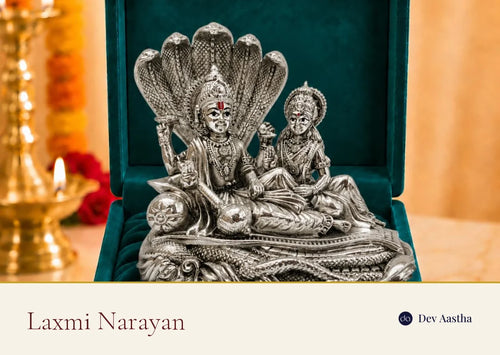
In their own primary forms, Vishnu and Lakshmi are worshipped together as Lakshmi Narayan. Our Laxmi Narayan story, significance and idol placement guide covers that pairing in full.

Every object around Lakshmi carries meaning. Reading her image is half the joy of worshipping her, so here is what the main symbols stand for.
Held together, the symbols tell one story. Lakshmi is not only money in a box. She is wealth balanced by purity, generosity and good sense, which is why she is shown so calm and so giving.
To worship Lakshmi at home, keep her corner clean and well lit, offer a lamp and flowers, and worship on Fridays and at Diwali. You can invoke the specific form that fits your need while honouring Maha Lakshmi as the whole.
Devotees often focus on one form depending on what their family is praying for:
You do not have to choose only one. Worshipping Maha Lakshmi covers them all, and many homes simply keep one idol and pray to her for whatever the season of life brings.
Friday is Lakshmi's day, ideal for a fresh flower, a lit lamp and a short prayer. Her great festival is Diwali, when Lakshmi Puja welcomes wealth and wellbeing for the year. In the south, the Ashta Lakshmi are honoured together during Varalakshmi Vratam in the month of Shravana.
Keep the idol in a clean pooja space, raised off the floor, ideally facing east or north. For the full room-by-room logic of placement, our guide to the Lakshmi Ganesh idol, its meaning and placement walks through it in detail. The short version: a bright, tidy north-east corner is the Goddess's favourite seat.
For most homes, a seated Lakshmi on a lotus, in the Gaja or Dhana Lakshmi form, is the natural choice. If you want all eight blessings in one piece, an Ashta Lakshmi idol or coin gathers the whole family of forms together.

Brass, marble and silver are all considered auspicious for a Lakshmi idol. Silver is especially loved for its cool lustre and its link to the moon and calm energy.
Our own pieces are silver-plated idols, with a layer of pure silver plating over a finely detailed core. That gives a true silver shine without the cost of solid silver. A handcrafted, hand-finished piece holds its detail for years, so you pay for craft and finish, not raw metal weight.
You can see the range in the Lakshmi idols collection. A simple silver-plated Lakshmi idol suits a daily pooja corner, while an Ashta Lakshmi tortoise carries all eight forms for those who want the complete blessing in one piece. Whatever you pick, the craftsmanship matters more than the size. One well-made idol, cared for, is the heart of a happy pooja room. That is the spirit behind every Dev Aastha piece.
The eight forms of Lakshmi, the Ashta Lakshmi, are Adi Lakshmi (the first form), Dhana Lakshmi (wealth), Dhanya Lakshmi (grain), Gaja Lakshmi (royal power), Santana Lakshmi (children), Veera Lakshmi (courage), Vijaya Lakshmi (victory) and Vidya Lakshmi (knowledge). Together they cover every kind of prosperity.
Adi Lakshmi, also called Maha Lakshmi, is considered the most powerful form. As the first and primordial form, she is the source of the other seven, so worshipping her honours all eight Ashta Lakshmi forms at once.
There is no single fixed number. The core set is the eight Ashta Lakshmi forms. Beyond these, Lakshmi descends with Vishnu in his avatars, as Sita with Rama, Rukmini with Krishna and Padmavati with Venkateswara. Some regional texts count sixteen or more forms.
Lakshmi is the goddess of wealth, prosperity and abundance, while Saraswati is the goddess of knowledge, learning and the arts. They are distinct goddesses, though Lakshmi's own Vidya Lakshmi form also blesses knowledge, which is why people sometimes link the two.
Gaja Lakshmi or Dhana Lakshmi is usually worshipped on Diwali, as the giver of wealth and royal abundance. Homes are cleaned and lit on Lakshmi Puja night so the Goddess feels welcome to enter and stay for the year ahead.
Maa Lakshmi ke mukhya aath roop hote hain, jinhe Ashta Lakshmi kaha jaata hai: Adi, Dhana, Dhanya, Gaja, Santana, Veera, Vijaya aur Vidya Lakshmi. Har roop alag tarah ki samriddhi deta hai, jaise dhan, anna, santaan, himmat aur gyaan. Maha Lakshmi ki pooja se in sabhi roopon ka aashirwad milta hai.
Related guides: The 10 avatars of Vishnu: the Dashavatar stories · The Kamdhenu cow: meaning and symbolism · Lakshmi Ganesh idol: meaning, placement and puja
Shop the collection: Lakshmi idols for home · Wealth and prosperity
Featured pieces: Lakshmi Silver-Plated Idol · Ashta Lakshmi Tortoise Silver-Plated Idol

Related guides: · Lakshmi charan paduka: placement as per vastu
Keep reading