Buying Guides
Lakshmi Ganesh Idol Set: Meaning, Significance and Where to Place It for Diwali
Sep 26, 2026


On a moonlit night in Vrindavan, a flute begins to play. The cowherd girls leave their homes and follow the sound to the river. At the heart of that gathering stand two figures the whole of Bhakti tradition has loved ever since: Krishna with his bansuri, and Radha, the one soul who loves him completely.
That single image holds the whole radha krishna significance in it. It is a love so pure that it became a path to God.
This guide tells their story honestly and in full. You will find the love story, the deeper meaning behind it, the questions everyone asks (why they never married, who was older, whether it all really happened), and how families keep their image at home today. A reader who simply loves the tale will find everything here, with no need to buy a thing.
Radha and Krishna are the beloved divine couple of Hinduism, worshipped together as the perfect picture of love and devotion. Krishna is the playful, all-knowing god of Vrindavan, and Radha is the gopi whose love for him became the model for every devotee.
Krishna is the eighth avatar of Vishnu, born to lift the weight of evil from the earth. His life is full of colour: the butter thief of Gokul, the flute player of the forests, the charioteer who later spoke the Bhagavad Gita to Arjuna. You can read where he sits among the other descents in our guide to the 10 avatars of Vishnu.
Radha is the daughter of Vrishabhanu, raised in the village of Barsana near Vrindavan. In devotional thought she is far more than a village girl. She is seen as Krishna's own Hladini Shakti, the energy of his bliss, so that the two are really one divine reality shown in two forms. That is why their names are almost always spoken together, with hers first, as Radha Krishna or Radhe Krishna.
To understand why a simple cowherd became the soul of an entire tradition, we have to walk back into the forests of Vrindavan where their story begins.
The radha krishna love story unfolds in Vrindavan, where Krishna spent his childhood and youth among the cowherds. It is a story of meeting, of joyful play, and finally of a separation that became the deepest part of their love.
As a young cowherd, Krishna would graze the cattle, tease the gopis, and play his flute by the Yamuna. Radha, a little older and already known for her grace, was drawn to that music like everyone else, yet her love ran deeper than the rest.
Their bond grew through small, human moments: shared glances, gentle teasing, long evenings by the river. The famous Raslila, the moonlit circle dance, is the high point of this time, when Krishna danced with every gopi at once yet belonged, in his heart, to Radha alone.
The turning point comes when Krishna leaves Vrindavan for Mathura to face his cruel uncle Kamsa. He is a boy when he goes, and he never returns to live among the cowherds again. Radha and Krishna are parted for the rest of their earthly lives.
This is the part many people miss. Their love is remembered not for a happy ending but for viraha, the ache of separation. Radha's longing for an absent Krishna became, for poets and saints, the perfect picture of a soul yearning for God. Krishna carried her in his heart through every later chapter, from king of Dwarka to guide on the battlefield.
So why does a love that ended in parting sit at the very centre of Hindu devotion? The answer lies in what it stands for.
The deepest radha krishna significance is spiritual, not romantic. Their love is a living symbol of the bond between the individual soul and the divine, which is the heart of the Bhakti path.
In this reading, Radha is the jivatma, the human soul, and Krishna is the Paramatma, the supreme being. Radha's complete, selfless longing for Krishna shows every devotee how to love God: with the whole heart, expecting nothing back. Her devotion is so total that her name is placed before his.
This is why saints across India held Radha as the ideal devotee. The poet-saint Mirabai sang of Krishna as her only beloved in exactly this spirit. To love as Radha loves is, in the Bhakti tradition, the surest way to reach the divine.
There is a second layer of radha krishna significance worth knowing. Together they represent the union of two eternal principles, and that idea is best understood through their symbolism.
Radha krishna symbolism rests on a single beautiful idea: the two are one. Krishna is the divine itself, and Radha is the power of that divine, so they can never truly be separated.
In devotional philosophy, Krishna is Shaktiman, the holder of all power, and Radha is his Shakti, the power itself. A fire and its heat, the sun and its light, a word and its meaning: this is how tradition explains a pair that is two and one at the same time.
Radha is named the Hladini Shakti, the energy of pure joy and love within Krishna. Without her, the texts say, even God could not taste the sweetness of being loved. In that sense Radha completes Krishna rather than merely loving him.
Their image carries layers of meaning that a single glance can hold:
Once you see them as one reality in two forms, the question people ask most often answers itself in a surprising way.
Radha and Krishna never married because their love was never meant to be bound by marriage. It stands above worldly ties as the union of the soul with God, and a wedding would have made it smaller, not greater.
Krishna later married Rukmini, Satyabhama and others as a king of Dwarka, and those were proper royal marriages. Radha, according to some traditions, was married to a cowherd named Ayan. Yet it is Radha, not any queen, whose name is joined with Krishna's in worship.
Tradition gives a few gentle reasons for this:
So the lack of a wedding is not a sad gap in the tale. It is the very point that makes their love divine rather than ordinary. A related question follows close behind it.
By popular belief, yes, Radha is usually thought to be a few years older than Krishna, though no scripture fixes their exact ages. The age difference between Radha and Krishna is part of folk tradition rather than firm scriptural fact.
Many retellings say Radha was around five years elder to Krishna, which is why some temples and stories present her as the more mature, guiding presence in the bond. This idea is widely loved, but it is worth being honest that it comes from later tradition and regional storytelling, not from a clear verse in the oldest texts.
What matters more than years is what the difference is meant to show. An older Radha represents the soul that has ripened in devotion, ready to love the divine fully. The point of the age difference between Radha and Krishna, in the end, is spiritual maturity, not arithmetic.
Questions like this lead naturally to a bigger one that thoughtful readers often raise.
Whether Radha existed as a historical person cannot be proven, and devotees and scholars hold different views. What is certain is that her story carries a spiritual truth that has shaped Hindu devotion for centuries.
Here is a fact many people find surprising. Radha is barely mentioned by name in the Bhagavata Purana, the great early text of Krishna's life. She rises to the very centre of the tradition later, above all in the Gita Govinda, the lyrical Sanskrit poem written by Jayadeva in the twelfth century.
From there, schools of devotion such as the Nimbarka Sampradaya and the Gaudiya Vaishnava tradition of Chaitanya Mahaprabhu placed Radha at the heart of worship. Her growing presence over time is not a weakness in the story. It shows how deeply the idea of loving devotion took root in the Indian heart.
So the honest answer has two parts: the history is uncertain, but the meaning is real and alive. And that living meaning is exactly what makes their love worth studying.
Radha and Krishna's love is loved today because it teaches lessons that outlast any era: selflessness, surrender, patience, and joy in the loving itself. These are the heart of what people call the seven promises of their love, a theme made popular by modern retellings and television.
Those dramatised "seven promises" are not from scripture, but the values behind them are genuine and worth holding onto:
| Lesson from their love | What it means for us |
|---|---|
| Selfless love | Radha asks for nothing, not even Krishna's presence. Real love gives freely. |
| Surrender | She places her whole heart in Krishna's hands, the spirit of true devotion. |
| Patience in separation | Their viraha shows that longing, borne with grace, can deepen love rather than break it. |
| Joy in devotion | The love itself is the reward, not what it gets in return. |
This is why couples, devotees and seekers all find something of their own in this pair. The love is large enough to hold a marriage, a friendship and a soul's search for God at the same time. Naturally, families want to keep that presence close, which brings us to worship at home.
Radha Krishna are worshipped at home with simple daily care: a clean spot in the pooja room, fresh flowers, a lit lamp, and gentle bhajans. The aim is warmth and devotion, not elaborate ritual.
Two days in the year are especially dear to their devotees:
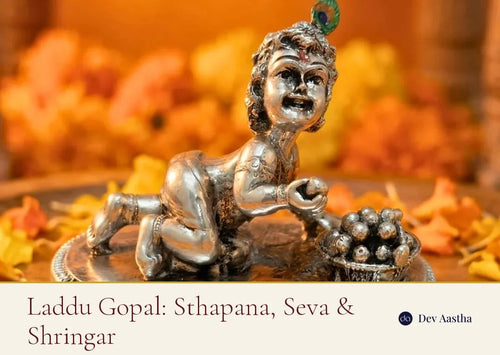
A paired Radha Krishna idol is the most loved form for the home, with Radha placed on Krishna's left, the side of the heart. Many families also keep a small Krishna with his flute, or a Laddu Gopal, the infant Krishna cared for like a beloved child of the house.

You can see the different forms in the Radha Krishna idols collection if you are setting up a new pooja corner. For where exactly to place the idol, our companion guide on placement and direction goes deeper than we can here.
Worship at home is also where the couple's meaning touches everyday life most closely, especially in matters of love and marriage.
Although they never married, Radha and Krishna are the favourite symbol of love and marital harmony in Indian homes. Their image is believed to bless a couple with closeness, understanding and lasting devotion.
This is the heart of the radha krishna relationship as people live with it today. Couples keep their idol to invite the kind of love the pair embodies: patient, selfless and joyful. It is one of the few divine forms traditionally welcomed even in a bedroom, kept small and respectful, for exactly this reason.
That is also why a Radha Krishna idol is such a treasured wedding and anniversary gift. It carries a blessing for the marriage rather than just a decorative charm, and it suits a modern home as easily as a traditional one.

Idols come in brass, marble and silver, and each is considered auspicious, so choose the look you love. Silver is especially prized for its cool lustre and its link to the moon and calm energy.
Our own pieces are silver-plated, a layer of pure silver plating over a finely detailed core. That gives genuine silver shine and crisp craftsmanship without the cost of solid silver, and a handcrafted, hand-finished idol holds its glow for years. You pay for the artistry and finish, not raw metal weight, which is good to know before you buy.
With the meaning, the story and the worship all in place, here are the questions readers ask most.
Radha Krishna are special because they represent the highest form of love, the union of the soul with God. Their bond is selfless and complete, asking for nothing in return. In the Bhakti tradition it is held as the ideal of devotion, not an ordinary romance.
Radha is worshipped with Krishna because she is seen as his Hladini Shakti, the very power of his love and joy, making the two one divine reality. Honouring Krishna without Radha is felt to be incomplete, which is why their names are spoken together as Radha Krishna.
In devotional thought, Radha is called Krishna's Shakti, the power through which the divine acts and feels. Some traditions say Krishna himself is bound by her love, so devotees lovingly place her name first. It reflects her supreme devotion, not a contest of strength between them.
Their love stood above worldly bonds, as the soul's union with God, which marriage could not contain. Krishna married royal queens like Rukmini, and Radha is said to have married a cowherd. Even so, it is their unbound love that tradition holds as divine and eternal.
By popular belief Radha was a few years older than Krishna, often said to be around five years elder, though no scripture fixes their exact ages. The idea comes from folk tradition and symbolises spiritual maturity, the soul ripened and ready to love the divine fully.
Radha aur Krishna ka rishta prem aur bhakti ka sabse uncha roop hai. Ve vivah ke bandhan mein nahin bandhe, phir bhi unka prem aatma aur parmatma ke milan ka prateek mana jata hai, isliye unhe sada saath mein Radha Krishna kehkar pooja jata hai.
Related guides: The 10 avatars of Vishnu · Understanding Mahadev: destroyer and yogi · How to choose god idols for your pooja room
Shop the collection: Krishna idols for home · Radha Krishna idols
Featured pieces: Premium Radha Krishna Idol (5.3") · Laddu Gopal Silver-Plated Idol

Explore more
Featured pieces: Vitthal Rukmini Silver-Plated Idol
Related guides: · Radha Krishna idol placement as per vastu · Laddu Gopal seva and shringar: a complete home guide · Radha Ashtami 2026 date and significance
Keep reading