Is Lord Venkateswara an Avatar of Vishnu? Exploring Their Divine Connection

Yes. In the Vaishnava tradition, Lord Venkateswara is an avatar of Vishnu, and most devotees go a step further and say he is Vishnu himself, fully present on the hill of Tirumala. He is not a separate god, and he is not a watered-down version of the Lord. He is the preserver of the universe in a settled, visible form that stays with us through the difficult age of Kali Yuga.
The deity is known by many names. Venkateswara, Balaji, Srinivasa, Govinda and Perumal all point to the same Lord. If you have ever stood in the long queue at Tirupati, or kept a Balaji idol in your home mandir, you have been in the presence of Vishnu in this form.
This guide answers the question fully. It explains what an avatar really means, the legend behind this form, the scriptural and visual proof, and the honest difference between saying "Vishnu" and saying "Venkateswara". You will get the complete picture whether or not you ever shop for an idol.
Key takeaways
- Yes, Venkateswara is Vishnu. Scripture and tradition treat him as a complete (Purna) manifestation of Lord Vishnu, not a partial or separate deity.
- He is a form, not one of the ten Dashavatara. Matsya, Rama and Krishna are the famous ten descents. Venkateswara is a distinct, self-manifested form for the Kali Yuga.
- Vishnu and Venkateswara are the same divinity. "Vishnu" is the cosmic preserver everywhere. "Venkateswara" is that same Lord enshrined and accessible at Tirumala.
- He is not an avatar of Krishna. Krishna and Venkateswara are both forms of Vishnu, related as siblings of the same source, not one born from the other.
- His two consorts, Sridevi and Bhudevi, are forms of Goddess Lakshmi, which is why he is worshipped with two wives.
In this guide: The short answer · What an avatar means · Why Vishnu took this form · Scriptural and visual proof · Difference between Vishnu and Venkateswara · Is he one of the ten avatars? · Is he an avatar of Krishna? · His two consorts · His form and posture · His many names · Honouring him at home · Final thoughts · FAQ
Is Lord Venkateswara an Avatar of Vishnu? The Short Answer
Lord Venkateswara is a direct and complete manifestation of Lord Vishnu, who took this form to remain present at Tirumala through the age of Kali Yuga. That is the settled view across scripture, temple tradition and the daily faith of millions.
The reason people still ask is the word "avatar". In common use it can mean a partial or temporary descent. With Venkateswara, the tradition is clear that this is a full presence of Vishnu, not a small portion of his power.
So when someone asks "is Venkateswara and Vishnu same", the honest answer has two layers. As divinity, they are one and the same. As form, Venkateswara is the specific shape that Vishnu took, and keeps, on the seven hills.
The same goes for the common search "is Venkateswara Swamy avatar of Vishnu". The answer is a clear yes, and the rest of this guide shows why, from the legend to the emblems on the idol.
The sections below unpack each layer. We start with what an avatar is, because the whole question turns on that one idea.
What an Avatar Means in Vaishnavism
An avatar is a deliberate descent of the divine into the world, taken on for a clear purpose. The word comes from the Sanskrit avatarana, which means "a crossing down". Lord Vishnu, the preserver, is the deity most linked with avatars.
Vishnu is believed to be present everywhere at all times. He does not need to travel anywhere. An avatar is simply the moment he chooses a visible form so that people can see him, pray to him and be guided by him directly.
Why the Divine Descends
The classic reason is given in the Bhagavad Gita. Lord Krishna says he appears in every age to protect the good, restrain wrongdoing and re-establish dharma, which means righteousness or moral order. The descents are never random.
A few clear purposes run through every avatar story:
- To restore dharma when righteousness fades and disorder grows.
- To protect the sincere, the devotees and the gentle-hearted.
- To check harmful forces that threaten peace and balance.
- To teach by example, showing how to live, rule or surrender.
Purna Avatars and Amsa Avatars
Tradition sorts avatars into two broad kinds. Knowing the difference is the key to Venkateswara's identity.
A Purna avatar is a complete manifestation. The Lord's full power, knowledge and grace are present, with nothing held back. Rama and Krishna are the best-loved examples of this fullness.
An Amsa avatar is a partial one. The word "amsa" means a part or a portion. Here only a chosen aspect of Vishnu's power appears for a specific task. These forms are still sacred and powerful, just narrower in scope.
This is exactly where Venkateswara fits, because he is held to be a Purna form, a complete presence of Vishnu, which is why devotees say he is Vishnu himself and not merely a small fragment of him.
Why Lord Vishnu Took the Venkateswara Form
Vishnu took the Venkateswara form to stay close to humanity during the Kali Yuga, a time when faith runs thin and people need an easy place to reach the divine. The story that explains it is one of the most loved legends in South India.
It is more than a tale. It carries deep ideas about devotion, debt, patience and grace. Here is how it unfolds, drawn from the Puranic accounts.
The Test of Sage Bhrigu
The legend opens in Vaikuntha, the heavenly abode of Vishnu. The sage Bhrigu arrives to decide which of the three great gods is supreme. To test Vishnu, he kicks the Lord on the chest while he rests.
Vishnu responds not with anger but with care, asking whether the sage's foot was hurt, and this humility settles the test. But the chest is the seat of Goddess Lakshmi, and she feels slighted that her sacred place was struck and not defended, so she departs from Vaikuntha for the earth.
Srinivasa and Padmavati
Pained by the parting from Lakshmi, Vishnu descends to the Seshachalam hills as Srinivasa, where he lives in quiet penance. There he eventually meets Padmavati, the daughter of Akasa Raja, who was the king of the surrounding land.
The two fall in love and a marriage is arranged. This union is not an ordinary royal wedding, but a cosmic event that brings the divine back into close contact with the human world for the good of all.
Padmavati is herself regarded as a form of Lakshmi, returned to the Lord's side on earth. So the separation that began with Bhrigu's test is healed through this sacred marriage.
The Loan From Kubera
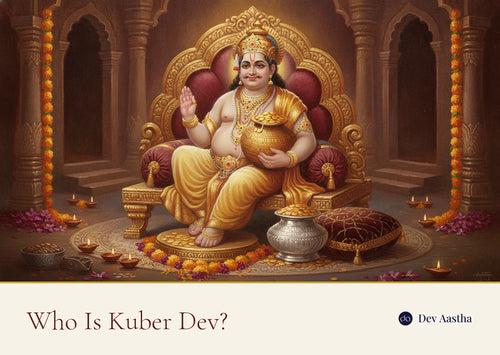
A grand wedding needs resources, even a divine one. Srinivasa approaches Kubera, the treasurer of the gods, for a loan to cover the marriage. Kubera, knowing exactly who Srinivasa is, agrees at once.
The Lord promises to repay the debt, with interest, by the end of the Kali Yuga, and this promise is the spiritual heart of the legend. The offerings that pilgrims drop into the temple hundi, the donation pot, are seen as helping the Lord gradually settle that eternal loan.
It is a tender idea. Your small offering joins a cosmic act of giving and receiving, and links your devotion to a promise made at the dawn of this age.
Settling at Tirumala
After the marriage, Srinivasa chooses to remain on the Tirumala hills for good. There he becomes known as Venkateswara, the Lord of the Venkata hill. He does not return to Vaikuntha.
This choice is the reason he is so beloved, because he stayed behind by his own will, so that anyone in this difficult age could come, see him and be blessed. His permanence at Tirumala is the living proof of his promise to remain present for us.
With the legend in place, the next question is whether scripture backs it up. It does, clearly.
Scriptural and Visual Proof of His Vishnu Identity
The Vishnu identity of Venkateswara rests on two firm supports: the ancient texts that name him, and the iconography of the idol itself, which carries Vishnu's own emblems. Together they leave little room for doubt.
What the Puranas Say
Several Puranas describe how Vishnu manifested on the Venkata hills. The accounts are detailed, not passing mentions. The key texts include:
- Varaha Purana, which links the sacred hill to Vishnu's Varaha form and his presence there.
- Bhavishyottara Purana, which narrates the Srinivasa legend and the Kali Yuga descent.
- Brahmanda and Padma Puranas, which praise the holiness of Tirumala.
- Sri Venkatachala Mahatmyam, a body of verses devoted to the glory of this very Lord.
For centuries devotees have read these as confirmation that the deity at Tirumala is Vishnu, present by his own choice in a fixed and reachable form.
The Emblems on the Idol
The image of Venkateswara is itself a statement of identity. Each detail repeats one message: this is Vishnu.
- Shankha and Chakra: the conch and the discus held in his upper hands are Vishnu's signature weapons.
- Srivatsa mark: the auspicious sign on the chest, the seat of Goddess Lakshmi.
- The lowered hand: one hand points to his feet, a gesture inviting surrender, promising refuge to anyone who bows there.
- The namam: the bright white-and-red mark on the face, worn by Vishnu's devotees.
These are not decorations. They are the recognised attributes of Vishnu, placed so that even a first-time visitor reads the form correctly.
A Note on the Other View
Now and then you will hear someone ask "why Venkateswara is not avatar of Vishnu", treating him as a wholly separate deity. This is a minority reading.
Against it stands the weight of the Puranas, the temple's own daily ritual and the unbroken faith of countless devotees. The mainstream verdict is settled: Venkateswara is Vishnu, in a form chosen for this age.
Difference Between Vishnu and Venkateswara: Are They the Same?
Vishnu and Venkateswara are the same divinity, with one difference of scope. Vishnu is the cosmic preserver who is everywhere and beyond form. Venkateswara is that same Lord in a specific, visible form, enshrined and reachable at Tirumala.
Think of it the way you might think of water and a river. Water is everywhere, in the air, the ground and the sky, while a river is that same water gathered into one place, where you can actually reach it, drink from it and be carried along by it.
That is the relationship. When you pray to Venkateswara, you pray to Vishnu. There is no lesser deity in between, and no rivalry. The form simply makes the formless approachable.
Where the Confusion Comes From
The confusion is mostly about language, not theology. People hear two names and assume two gods. A few reasons feed the doubt:
- Different names for the same Lord can sound like different deities to a newcomer.
- The local legend of Srinivasa gives Venkateswara a personal earthly story, which feels distinct from the cosmic Vishnu.
- Regional worship centred on Tirumala can seem separate from the wider worship of Vishnu.
None of these change the core truth. Ask any priest at Tirumala and the answer is plain: the Lord on the hill is Vishnu. So if you have wondered "is Lord Vishnu and Lord Venkateswara same", you can rest the question. They are one.
Is Venkateswara One of Vishnu's Ten Avatars (Dashavatara)?
No. Venkateswara is not one of the ten Dashavatara avatars. He is a separate, self-manifested form of Vishnu for the Kali Yuga, which is why you will not find him in the standard list of ten.
The Dashavatara are the ten classic descents of Vishnu, each with a clear mission to defeat a threat and restore order. Venkateswara's role is different. He stands still on the hill and offers grace, rather than going to war.

The Ten Avatars in Order
For context, here are the ten avatars that the Dashavatara names, the list people picture when they think of Vishnu's avatars:
- Matsya, the fish who saved the Vedas from a flood.
- Kurma, the tortoise who upheld a mountain during the churning of the ocean.
- Varaha, the boar who lifted the earth from the cosmic waters.
- Narasimha, the man-lion who protected the devotee Prahlada.
- Vamana, the dwarf who measured the worlds in three steps.
- Parashurama, the sage-warrior with the axe.
- Rama, the ideal king of the Ramayana.
- Krishna, the divine guide of the Bhagavad Gita.
- Buddha, counted in many traditions as the ninth.
- Kalki, the avatar yet to come at the end of Kali Yuga.
Venkateswara sits outside this list, in the family of Vishnu's enduring forms. People who search "lord venkateswara 10 avatars" are usually surprised by this, but it does not lessen him. A complete form of Vishnu is fully Vishnu, list or no list.
How He Differs From Rama and Krishna
The contrast with the famous avatars makes his nature clear. A short comparison helps:
| Aspect | Lord Venkateswara | Avatars like Rama and Krishna |
|---|---|---|
| Main role | Giving blessings and refuge in Kali Yuga | Defeating evil and restoring dharma |
| Form | Still, standing, eternally present on Tirumala | Active, living through specific life stories |
| How he acts | Through darshan, grace and surrender | Through war, kingship and direct deeds |
| Where he is found | Tirumala, permanently | Ayodhya, Mathura and the lands of their stories |
Rama and Krishna lived through their missions and returned. Venkateswara chose to stay. That choice to remain accessible is his defining trait.
Is Venkateswara an Avatar of Krishna?
No, Lord Venkateswara is not an avatar of Krishna. Both Venkateswara and Krishna are forms of the same Lord Vishnu. They are like two expressions of one source, not one born from the other.
The mix-up is easy to understand. Krishna is the most famous avatar of Vishnu, so people sometimes assume every later form must come through him. They also share the name Govinda, which adds to the blur.
But the lineage runs the other way. Both forms flow from Vishnu directly. Krishna appeared in the Dwapara Yuga for his mission, while Venkateswara stays through the Kali Yuga for ours. They are siblings of the same divine source.
Some people phrase it as Venkateswara being an avatar "after Krishna", since Krishna belongs to the earlier Dwapara Yuga and Venkateswara to the present Kali Yuga. The order in time is real, but it does not make one the source of the other. Both descend straight from Vishnu.
So if you have seen the question "is venkateswara swamy avatar of krishna", the clean answer is this: he is an avatar, or rather a complete form, of Vishnu, and Krishna is too. They meet in Vishnu, not in each other.
His Two Consorts and Why He Has Two Wives
Lord Venkateswara is worshipped with two consorts, Sridevi and Bhudevi, who are both forms of Goddess Lakshmi. This is why he is often said to have two wives. It is symbolic, not a tale of two separate human marriages.
Lakshmi, the goddess of fortune, is never apart from Vishnu. At Tirumala she is honoured in two aspects, each carrying a different blessing. Understanding them deepens the whole story.
Sridevi, the Form of Fortune
Sridevi is Lakshmi in her familiar role as the giver of wealth, grace and spiritual abundance. She is the goddess who rests on Vishnu's chest at the Srivatsa mark, ever beside the Lord.
On earth she is linked with Padmavati, the princess Srinivasa married, who is worshipped at the nearby Tiruchanur temple as Alamelu or Alamelumanga. Devotees often visit her shrine before climbing to the main temple.
Bhudevi, the Earth Goddess
Bhudevi is Lakshmi as the goddess of the earth itself. She represents patience, fertility and the grounded support of all life. Her presence shows the Lord's bond with the physical world we live in.
Together the two goddesses balance the Lord's gifts, since one offers fortune and liberation, while the other offers stability and earthly care. A devotee who honours both consorts therefore receives a complete and well-rounded blessing.
The Meaning Behind the Two
The two consorts are not about romance in the human sense. They show the full reach of the Lord, who looks after both our spiritual growth and our worldly needs.
This is also a quiet reminder that prosperity and grace come as a pair. The Lord and Lakshmi are inseparable, so worship of Venkateswara is always, in part, worship of abundance and goodwill together.
What Lord Venkateswara's Form and Posture Reveal
The form of Venkateswara is full of meaning, and every part of it points back to Vishnu and to the way he chooses to bless us. He stands upright, richly adorned, with his gaze almost hidden behind the namam. Reading the form deepens the answer to who he really is.
The Standing Posture
Venkateswara is shown standing, not seated or reclining, and the standing posture itself is a sign of readiness. He is upright and alert, always available to receive a devotee, and never resting or turned away from those who come.
It also marks him apart from the active avatars, since Rama and Krishna are pictured in motion within their life stories. Venkateswara, by contrast, is still and fixed, a steady presence that you can return to again and again on the very same hill.
The Hand That Points to His Feet
One of his lower hands points down toward his feet. This simple gesture carries the whole message of the shrine. It tells the devotee that refuge lies at his feet, and that those who surrender there will be carried across life's troubles.
The other lower hand rests at his waist, a sign that the ocean of worldly fear is only waist-deep for one who takes shelter with him. Together, the two hands turn the entire idol into a quiet but powerful promise of protection and refuge.
The Emblems of Vishnu, Again
His upper hands hold the shankha and chakra, the conch and discus that belong to Vishnu alone. No other deity carries this exact pair in this way. For a devotee, seeing them settles any question about whose form this is.
The namam on his face, the flowers and silks that cover him, and the goddess at his chest all repeat the same truth. This is the preserver of the universe, dressed in love by his devotees, standing where they can find him.
Why He Is Called Self-Manifested
Tradition holds that the main idol at Tirumala is svayambhu, which means self-manifested rather than carved by human hands. This belief adds to his power in the eyes of devotees, since the form is seen as the Lord's own choice of shape.
A self-manifested deity is felt to be especially alive and present. It is one more reason the faithful speak of Venkateswara not as a statue of Vishnu, but as Vishnu truly here, looking back at them through the namam.
Balaji, Srinivasa, Govinda: His Many Names
Lord Venkateswara is known by many names, and they all refer to the same Vishnu on the hill. The names come from his stories, his hill and the languages of his devotees, not from different gods.
This is often the root of the "is balaji vishnu avatar" question. People meet the Lord under one name in their region and a different name elsewhere, and wonder if they are praying to the same deity. They are.
Here are the names you will hear most, and where each comes from:
- Balaji: the popular North and West Indian name, used widely for the Tirupati Lord.
- Srinivasa: the name from the legend, meaning the one in whom Lakshmi (Sri) resides.
- Govinda: the joyful chant raised in the temple, a name shared with Vishnu and Krishna.
- Venkatachalapati: the lord of the Venkata hill, a direct title of place.
- Perumal: the Tamil name, meaning the great one, common in South India.
One Lord, many doorways. Whether you call him Balaji at a home mandir in Delhi or Perumal at a temple in Tamil Nadu, you are turning to Vishnu in his Tirumala form. The choice of name is about love and habit, never about a different god.
For a wider look at his classic ten descents, our guide to the ten avatars of Vishnu and their stories sits naturally beside this one.
Honouring Lord Venkateswara at Home
To honour Lord Venkateswara at home, keep his idol or image in a clean east or north-facing spot, offer a daily diya and fresh flowers, and chant his simple names. A steady, sincere routine matters more than an elaborate one.
Many families like to bring his presence into the house so the blessing of Tirumala feels close every day. A small home mandir, kept with care, is enough.
A Simple Daily Practice
You do not need a long ritual. A short, regular puja carries real devotion:
- Clean the space and wipe the idol gently before you begin.
- Light a diya with ghee or oil, and an incense stick if you like.
- Offer flowers and a simple bhog, such as fruit or a sweet.
- Chant his name: "Om Namo Venkatesaya" or a heartfelt "Govinda, Govinda".
- Sit quietly for a moment of gratitude to close the prayer.
The Govinda chant is the same one that echoes through Tirumala. Saying it at home is a gentle way to feel joined to that great stream of devotion.
Saturday is traditionally held to be the Lord's special day, so many devotees keep a simple fast or offer extra prayers then. Some also observe the months of Purattasi in the Tamil calendar with weekly worship of Venkateswara.
A small bowl of sweet prasad is a lovely touch. The famous Tirupati laddu cannot be made at home, but offering any pure, freshly made sweet and sharing it with family carries the same spirit of grace received and passed on.

Choosing an Idol, Honestly
Look for an idol that shows the true emblems: the conch and discus in the upper hands, the namam on the face and the calm standing posture. These details mark it as a faithful Venkateswara form.
On material, a little honesty helps. A solid sterling-silver idol is sold by weight and runs very costly, often beyond what a home shrine needs. A silver-plated Venkateswara idol gives the same bright, sacred glow at a far gentler price. Our pieces are pure silver plating over a sculpted resin core, hand-finished for fine detail, with no solid-metal claims attached.
Match the size to your altar. For a home shrine, a piece of roughly 3 to 5 inches feels personal and easy to care for, while a smaller Balaji car dashboard idol suits a vehicle. You can see a range of forms in our Balaji idols collection as you decide.
Whatever you choose, the idol is a focus for your faith, not a measure of it. A sincere prayer before a small image reaches the Lord just as surely as a grand one.
Final Thoughts
After the legend, the scripture and the emblems, the answer is steady. Lord Venkateswara is an avatar of Vishnu, and in the fullest sense he is Vishnu himself, settled on Tirumala to bless us through this age.
He is not one of the ten Dashavatara, and he is not a form of Krishna. He is a complete presence of the preserver, who chose to stay where anyone could reach him. That choice is the whole heart of his appeal.
Whether you make the pilgrimage to Tirupati or keep a small Balaji idol in your home mandir, you are turning to the same compassionate Lord. The name you use only reflects your own corner of a very large devotion.
If his story has drawn you in, you may enjoy reading our guide to authentic Tirupati Balaji statues for the home next.
Frequently Asked Questions
Is Lord Venkateswara an avatar of Vishnu?
Yes. Texts such as the Varaha Purana and Bhavishyottara Purana describe Lord Venkateswara as a complete (Purna) manifestation of Lord Vishnu, who descended to Tirumala to bless humanity through the Kali Yuga. Most devotees treat him as Vishnu himself in a settled form.
Is Venkateswara and Vishnu the same?
Yes, they are the same divinity. Vishnu is the cosmic preserver present everywhere, and Venkateswara is that same Lord in a specific, visible form enshrined at Tirumala. Praying to Venkateswara is praying to Vishnu, with no lesser deity in between.
Is Venkateswara one of the ten avatars of Vishnu?
No. The Dashavatara are ten descents such as Matsya, Rama and Krishna. Venkateswara is a separate, self-manifested form of Vishnu for the Kali Yuga, so he is not counted among the ten. A complete form of Vishnu is still fully Vishnu.
Is Venkateswara Swamy an avatar of Krishna?
No. Lord Venkateswara is a form of Lord Vishnu, not of Krishna. Krishna is also an avatar of Vishnu, so the two are related as expressions of the same source rather than one being born from the other. They share the name Govinda, which can cause confusion.
Why did Lord Vishnu take the Venkateswara form?
Vishnu took this form to stay close to people during the Kali Yuga, an age of weak faith. The legend tells of his descent as Srinivasa, his marriage to Padmavati and a loan from Kubera, after which he chose to remain on Tirumala permanently to grant blessings.
Who are Lord Venkateswara Swamy's wives?
He is worshipped with two consorts, Sridevi and Bhudevi, both forms of Goddess Lakshmi. On earth, Sridevi is linked with Padmavati, honoured at Tiruchanur as Alamelu. The two represent fortune and the earth, showing the Lord's care for both spiritual and worldly life.
Kya Tirupati Balaji Bhagwan Vishnu ka avatar hain?
Haan. Tirupati Balaji, yaani Lord Venkateswara, ko Bhagwan Vishnu ka poorn (Purna) roop maana jaata hai. Veh Kali Yuga mein bhakton ko ashirwad dene ke liye Tirumala par swayam prakat hue. Balaji aur Vishnu alag dev nahin, ek hi divya shakti ke do naam hain.
Explore more
Related guides: Authentic Tirupati Balaji statues for the home · The ten avatars of Vishnu (Dashavatar) stories
Shop the collections: Balaji idols · Vishnu idols

Written by Arun Mehta · Updated June 2026
Arun covers Hindu traditions, vastu and festivals for Dev Aastha, translating time-honoured practices into clear, practical guidance for modern Indian homes. His writing draws on scriptural sources and the lived traditions of devout households.
Arun covers Hindu traditions, vastu and festivals for Dev Aastha, translating time-honoured practices into clear, practical guidance for modern Indian homes. His writing draws on scriptural sources and the lived traditions of devout households.
Keep reading
More from the journal