12 Most Powerful Hindu Gods (and What Each One Represents)

Ask ten devout Hindus to name the single most powerful god and you may get ten different answers. A Shaiva will say Shiva. A Vaishnava will say Vishnu. A Bengali grandmother lighting a lamp for Durga will smile and say the Mother holds them all.
None of them is wrong. Hinduism does not crown one god above the rest the way some faiths do. Instead it holds a bigger idea: that every deity is a face of one boundless reality, and each carries a distinct power the others do not.
This guide answers the question everyone asks about the most powerful Hindu gods honestly. It explains why there is no single winner, introduces the Trimurti and the goddesses, and then profiles twelve major deities and exactly what each one represents.
Key takeaways
- There is no single most powerful god in Hinduism. The oldest texts teach that all gods are forms of one supreme reality called Brahman, so power is shared rather than ranked.
- The Trimurti divides the running of the universe between Brahma the creator, Vishnu the preserver, and Shiva the destroyer and transformer.
- The Tridevi, Saraswati, Lakshmi and Parvati, carry the active energy or Shakti, and in the Shakta tradition the Goddess is held as the highest power of all.
- Among the most powerful Hindu gods worshipped daily are Shiva, Vishnu, Krishna, Rama, Ganesha, Hanuman, Durga, Kali, Lakshmi and Saraswati.
- Most families choose one Ishta Devata, a personal deity they hold closest, while still respecting every other god in the home shrine.
Who is the most powerful god in Hinduism?
The honest answer is that Hinduism names no single most powerful god, because it teaches that all gods are expressions of one infinite reality called Brahman. Asking who is the most powerful god is a little like asking which wave is the most powerful part of the ocean.
The Rigveda puts it in one famous line: "Ekam sat vipra bahudha vadanti", meaning truth is one, though the wise call it by many names. Every deity, in this view, is a doorway to the same boundless source.
People often say Hinduism has "33 crore", or 330 million, gods. This is a common misreading. The old texts speak of 33 koti, and koti means type or category as well as crore. The tradition counts thirty-three principal deities, not a literal 330 million.
So when people ask who is the most powerful god in Hinduism, the mature reply is simple. The many gods are forms of Brahman. Each one shows a single face of the divine. Shiva shows its stillness, Vishnu its care, Durga its fierce protection.
Where a ranking does appear, it comes from tradition rather than scripture. Hindus belong to different schools, and each school holds its chosen deity as supreme while honouring the rest.
- Shaivism holds Shiva as the supreme being and source of all.
- Vaishnavism holds Vishnu, and his forms Rama and Krishna, as the highest.
- Shaktism holds the Goddess, Devi or Adi Shakti, as the ultimate power.
- Smartism treats five major deities as equal paths to the same truth.
This is why the question has no fixed winner. A temple town in Tamil Nadu and one in Bengal can each name a different god as greatest, and both are right. To see how the load is shared, start with the three who run the cosmos.
The Trimurti: the three gods who run the universe
The Trimurti is the Hindu idea that one supreme power works through three gods: Brahma who creates, Vishnu who preserves, and Shiva who dissolves. He dissolves so that creation can begin again. Together they turn the endless wheel of time.
Think of it as three jobs rather than three rivals. The universe is born, it is kept in balance, and it is finally withdrawn, only to be reborn. Each god owns one stage of that cycle, and none can do the work of the others.
Brahma brings the worlds into being. Vishnu keeps them running and steps in whenever order breaks down. Shiva ends each cycle so a fresh one can rise, which makes him a force of renewal, not mere destruction.

Each god of the Trimurti is paired with a goddess who carries his active power. Brahma with Saraswati, Vishnu with Lakshmi, and Shiva with Parvati. Creation and its energy always move as a pair.
With that frame in place, we can meet the gods themselves, starting with the two the Trimurti places at the centre of daily worship.
The 12 most powerful gods in Hinduism and what they represent
These twelve are among the most powerful gods in Hinduism by worship, scripture and reach, spanning the Trimurti, the great avatars, the warrior deities and the goddesses. Each entry explains the god's role and what devotees ask of them.
The list is not a ranking. You could name the most powerful Hindu gods in any order and each devotee would arrange them differently. What unites them is scale: temples across India, festivals that pause daily life, and a place in scripture that spans thousands of years.
1. Shiva, the destroyer and the great ascetic
Shiva, often called Mahadev or the great god, dissolves each cycle of creation so a new one can begin. To his followers he is the supreme reality itself, the still centre from which everything flows.
He is the god of meditation, time and transformation. His symbols carry meaning: the third eye of inner sight, the crescent moon, the Ganga in his hair, and the trident of the three gunas. He is also worshipped in the form of the lingam.
As Nataraja, the lord of the cosmic dance, Shiva keeps the whole universe moving through his tandava. During the churning of the ocean he drank the world's poison to save creation, earning the name Neelkanth, the blue-throated one. Few images capture power held in perfect stillness so well.

Devotees turn to him for inner strength, the calm to face change, and release from fear. Mahashivratri is his great night, and a simple silver-plated Shiva idol in meditation is a favourite for a quiet corner. His full story sits in our guide to Mahadev.
2. Vishnu, the preserver of the universe
Vishnu keeps the universe in balance and protects dharma, or cosmic order. Whenever evil grows too strong, he descends to earth in a new form to set things right, which is the idea behind his avatars.
He is usually shown with four arms holding a conch, a discus, a mace and a lotus, resting on the serpent Ananta in the cosmic ocean. His ten main avatars, the Dashavatar, include Rama and Krishna, with Kalki still to come. You can read their stories in our Dashavatar guide.
His heaven is Vaikuntha, and his devotees seek stability, protection and grace in daily life. In South India he is worshipped as Venkateswara at Tirupati, one of the most visited shrines on earth, drawing tens of thousands of pilgrims every single day.
3. Brahma, the creator
Brahma is the creator of the cosmos, shown with four heads that face the four directions and recite the four Vedas. His power is the act of creation itself, the first stir of life out of the void.
Oddly for so senior a god, Brahma has very few temples, the most famous being at Pushkar in Rajasthan. Old legends explain this with a curse, and in practice Hindus honour creation more than they worship the creator directly. His consort is Saraswati, goddess of knowledge.
4. Krishna, the divine statesman and teacher
Krishna is the eighth avatar of Vishnu and, for millions, the supreme god in his own right. He is the playful cowherd of Vrindavan, the devoted friend, and the charioteer who delivers the Bhagavad Gita on the battlefield of Kurukshetra.
His power is wisdom joined to love. He teaches action without attachment, and shows that the divine can be near, human and full of joy. His bond with Radha is explored in our Radha Krishna guide. Janmashtami marks his birth.
5. Rama, the ideal king
Rama, the seventh avatar of Vishnu, is honoured as Maryada Purushottam, the perfect man who never strays from duty. The Ramayana follows his exile, the abduction of Sita, and his victory over the demon king Ravana.
Devotees look to him for the strength to do the right thing even when it costs dearly. His return to Ayodhya is celebrated as Diwali, and Ram Navami marks his birth. He is rarely far from Hanuman, his greatest devotee.
6. Ganesha, the remover of obstacles
Ganesha, the elephant-headed son of Shiva and Parvati, is worshipped first, before any other god, at the start of every ritual, journey or new venture. That is his unique privilege among the gods.
He is Vighnaharta, the remover of obstacles, and the patron of wisdom and beginnings. A small silver-plated Ganesha idol sits at the doorway or desk of countless Indian homes for exactly this reason.

Ganesh Chaturthi is his grand festival, when clay idols are welcomed home for ten days. His broken tusk, his mouse mount and his love of modak all carry their own lessons about humility and balance.
7. Hanuman, the devoted and mighty protector
Hanuman is the vanara devotee of Rama, and the model of perfect bhakti, or devotion. Son of the wind god Vayu, he has boundless strength, yet uses it only in service, never for himself.
He is one of the Chiranjivi, the immortals believed to live on through every age. Devotees chant the Hanuman Chalisa for courage and protection, especially on Tuesdays and Saturdays. His powers are explored in our guide to Lord Hanuman.
8. Durga, the invincible mother
Durga is the warrior form of the Goddess, created by the combined energy of all the gods to defeat the buffalo demon Mahishasura, whom none of them could beat alone. She is Adi Shakti, the primal power.
Riding a lion and bearing a weapon from each god in her many arms, she stands for protection, courage and the triumph of good over evil. Navratri honours her nine forms, the Navadurga, described in our Navadurga guide.
Her victory over Mahishasura is remembered as Mahishasuramardini, the slayer of the buffalo demon, and it is why her worship carries such fierce energy. During Durga Puja in Bengal, whole cities build grand pandals to welcome the Mother home for a few luminous days.
9. Kali, the fierce force of time
Kali is the most intense form of the Goddess, dark as the void, garlanded with skulls, her tongue out in wild energy. She destroys ego and illusion, the inner demons that ordinary worship cannot reach.
Frightening at first sight, she is in truth a fiercely loving mother to her devotees. She is worshipped widely in Bengal, especially at Dakshineswar and on Kali Puja night. Her power is the courage to face death and change without flinching.
10. Lakshmi, goddess of wealth and fortune
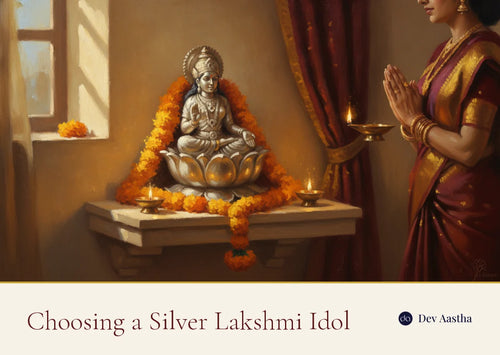
Lakshmi is the goddess of wealth, prosperity, beauty and good fortune, and the consort of Vishnu. She is shown seated on a lotus, gold coins flowing from her hand, calm and gracious.
Her wealth is not only money but abundance of every kind: health, harmony and grace. Families welcome her on Diwali with lamps and clean, open doors. Her eight forms, the Ashta Lakshmi, are covered in our Ashta Lakshmi guide. She is almost always worshipped beside Ganesha, so that new wealth arrives free of obstacles and put to wise use.
11. Saraswati, goddess of knowledge and the arts
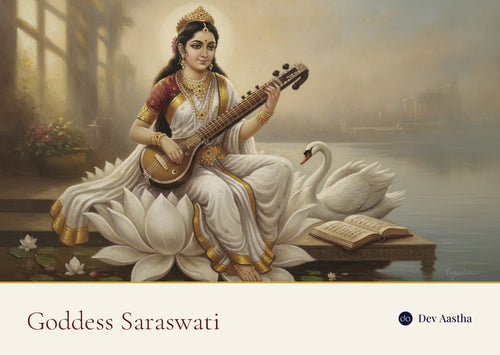
Saraswati is the goddess of learning, speech, music and the arts, and the consort of Brahma. Dressed in white, playing a veena, with a book and a swan beside her, she stands for the wealth that thieves cannot steal.
Students and artists honour her on Vasant Panchami, placing books and instruments at her feet. Her symbols and forms are explained in our Saraswati guide. She completes the Tridevi with Lakshmi and Parvati.
12. Kartikeya, the commander of the gods
Kartikeya, also called Murugan, Skanda or Subramanya, is the second son of Shiva and Parvati and the general of the divine army. He rides a peacock and carries the vel, a sacred spear given by his mother.
He is the god of war, victory and youthful courage, and is hugely loved across South India, where his hilltop temples at Palani and Tiruchendur draw millions. Thaipusam is his best-known festival, a day of vows and devotion. In Tamil tradition he is also the god of wisdom, said to have taught even his own father the meaning of a single sacred syllable.
Shakti and the Tridevi: the power of the goddesses
In Hinduism the goddesses are not junior partners to the gods; they are Shakti, the active energy without which the gods cannot act at all. This is why many traditions name a goddess as the most powerful hindu goddess and the highest power of all.
The word Shakti means power or energy. A god may hold the potential, but it is his Shakti, his goddess, who makes it move. A common saying is that Shiva without Shakti is inert, like a body without breath.
The Tridevi are the three great goddesses who partner the Trimurti. Saraswati carries the power of knowledge, Lakshmi the power of wealth and nourishment, and Parvati, in her forms as Durga and Kali, the power of protection and transformation.
In the Shakta tradition these are all faces of one supreme Goddess, Adi Parashakti, the mother of the universe. For her devotees the answer to who holds the greatest power is simple: the Devi, from whom even the great gods draw their strength.
That balance of god and goddess, potential and power, runs through every Hindu shrine. It also shapes how families decide which deities to keep, which the next section makes practical.
Hindu gods by their power and domain
Each major deity is turned to for a specific kind of help, which is why a home shrine often holds several. This quick reference maps the leading gods to their role, what devotees pray for, and their main festival.
| Deity | Role or power | Worshipped for | Main festival |
|---|---|---|---|
| Shiva | Destroyer and transformer; the great ascetic | Inner strength, calm, release from fear | Mahashivratri |
| Vishnu | Preserver; protector of dharma | Stability, protection, order in life | Ekadashi, Vaikuntha Ekadashi |
| Brahma | Creator of the worlds | New beginnings, creativity | Rarely, at Pushkar |
| Krishna | Avatar of Vishnu; teacher and guide | Wisdom, love, right action | Janmashtami |
| Rama | Avatar of Vishnu; the ideal king | Duty, integrity, courage | Ram Navami, Diwali |
| Ganesha | Remover of obstacles; lord of beginnings | Success, wisdom, smooth starts | Ganesh Chaturthi |
| Hanuman | Devotee of Rama; mighty protector | Strength, protection, devotion | Hanuman Jayanti |
| Durga | Warrior Goddess; Adi Shakti | Protection, courage, victory over evil | Navratri, Durga Puja |
| Kali | Fierce force of time and change | Freedom from ego and fear | Kali Puja |
| Lakshmi | Goddess of wealth and fortune | Prosperity, abundance, harmony | Diwali |
| Saraswati | Goddess of knowledge and the arts | Learning, focus, creativity | Vasant Panchami |
| Kartikeya | Commander of the gods; god of war | Courage, victory, discipline | Thaipusam |
No single row outranks the rest. A student leans on Saraswati, a new shop owner on Lakshmi and Ganesha, a worried parent on Hanuman. The right god is the one whose power meets your need, which brings us to a very personal idea.
What is an Ishta Devata, and which god should you worship?
An Ishta Devata is your chosen personal deity, the one god or goddess you hold closest and worship most sincerely, without ever denying the others. It is the Hindu answer to the question of which god you should worship.
The word means the cherished or beloved deity. You may keep many gods in your shrine, yet feel one is truly yours, the form through which the divine feels most alive to you. That is your Ishta Devata.
How do people choose? Often the deity is passed down through the family, the kuladevata worshipped for generations. Sometimes it is the god of one's birth star or region. Just as often, it is simply the deity a person feels drawn to.
There is real freedom here. A devotee of Krishna and a devotee of Durga can share the same home and the same festivals without conflict. Each worships the whole through a form they love, which is the quiet genius of the tradition.
If you are unsure where to begin, most families start with Ganesha, since he clears the path, and add the deity closest to their heart. That instinct guides which idols come into the home.
How Hindu families keep the gods at home
Most Indian homes keep a small mandir with two or three deities: usually Ganesha, the family Ishta Devata, and a goddess such as Lakshmi. The aim is a calm, cared-for space, not a crowded gallery of every god.
Placement follows simple habits. The shrine sits in the north-east or east where the morning light falls, idols face west or east, and nothing is crowded or left dusty. Ganesha is usually placed first, and gods are kept a little above eye level.
Material matters less than devotion, though many families choose silver-plated idols for the bright, lasting lustre they bring to a mandir. Our pieces are pure silver plating over a resin core, hand-finished for detail, so they carry a genuine silver glow without the cost of solid silver.
A protective deity like Hanuman is a common choice for the entrance or car, and a silver-plated Hanuman idol is a favourite for exactly that role. Choose what your family reveres, keep it clean, and light a lamp with a steady mind.
A well-chosen trio covers most needs. Ganesha clears obstacles, Lakshmi invites prosperity, and a protector like Hanuman or the family deity guards the home. Many north-Indian households also keep a Lakshmi-Ganesh pair together, the classic pairing for a Diwali mandir.
Whichever gods you welcome, the care you give them matters more than their number. A single idol tended with love outweighs a shelf of neglected ones, which is the truest measure of worship at home.
Frequently asked questions
Who is the most powerful god in Hinduism?
Hinduism names no single most powerful god. Its oldest texts teach that all deities are forms of one supreme reality called Brahman, so power is shared. Within traditions, Shaivas hold Shiva supreme, Vaishnavas hold Vishnu, and Shaktas hold the Goddess, while the Trimurti of Brahma, Vishnu and Shiva together govern the universe.
Who is the most powerful Hindu goddess?
Durga, the warrior form of the Goddess, is widely regarded as the most powerful hindu goddess, since she was made from the combined energy of all the gods to defeat a demon none of them could beat. In the Shakta tradition she is Adi Parashakti, the primal power from which even the great gods draw their strength.
Is Shiva or Vishnu more powerful?
Neither is fixed as greater; it depends on tradition. Shaivas hold Shiva as the supreme being, while Vaishnavas hold Vishnu as the highest. Most Hindus see them as two faces of the same Brahman, each governing a different part of the cosmic cycle, so the two are honoured as equals rather than ranked.
Why is Brahma the creator rarely worshipped?
Although Brahma is one of the Trimurti, he has very few temples, the best known being at Pushkar in Rajasthan. Old legends explain this with a curse. In practice, Hindus tend to honour the act of creation and the ongoing care of the world more than the creator himself, and that care belongs to Vishnu and Shiva.
Which god should I worship first at home?
Ganesha is worshipped first in almost every Hindu ritual, because he is the remover of obstacles and the lord of beginnings. Many families keep a Ganesha idol at the doorway or in the mandir, then add their Ishta Devata, the personal deity they hold closest, along with a goddess such as Lakshmi.
Hindu dharm mein sabse shaktishali bhagwan kaun hai?
Hindu dharm mein koi ek sabse shaktishali bhagwan nahi hai. Prachin granth kehte hain ki sabhi devi-devta ek hi param satya, Brahman, ke roop hain. Shaiv log Shiv ko, Vaishnav log Vishnu ko, aur Shakt log Devi ko sarvocch maante hain, jabki Brahma, Vishnu aur Mahesh milkar srishti chalate hain.
Explore more
Related guides: Understanding God Mahadev · The 10 avatars of Vishnu · The 9 forms of Durga
Shop the collection: God idols for home · Silver-plated murti collection
Featured pieces: Standing Balaji silver-plated idol · Premium Radha Krishna idol

Arun Mehta
Arun covers Hindu deities, tradition and vastu for Dev Aastha, translating time-honoured practices into clear guidance for modern Indian homes.
Arun covers Hindu deities, tradition and vastu for Dev Aastha, translating time-honoured practices into clear guidance for modern Indian homes.
Keep reading
More from the journal