

Vastu Items for Home: The Complete Room-by-Room Checklist

Last updated 24 October 2026 · By Sneha Kulkarni
Walk into any festival market in India and someone will sell you a pyramid, a frog sitting on coins, and a brass fish, all under one signboard that says vastu. Three objects, three different traditions, and only one of them is actually from vastu shastra.
That confusion is the whole problem with shopping for vastu items for home. The lists online are mostly the same eleven objects in a different order, with no explanation of where each one came from or why a direction is being recommended.
This is the checklist version instead. Room by room, zone by zone, with the honest distinction between what classical Indian texts actually describe and what arrived later from Chinese feng shui. Your main door is the one zone this guide leaves out, because it needs its own guide and already has one.
Key takeaways
- Direction does more work than the object. A tulsi plant in the north-east helps; the same plant in the south-west is just a plant in the wrong corner.
- Roughly half the "vastu items" sold in India are feng shui. Laughing Buddha, arowana fish, wind chimes, the three-legged frog and the horseshoe are Chinese in origin. Keep them if you like them, but know what you are keeping.
- The classical texts are about buildings, not showpieces. Mayamata, Manasara and the others describe proportion, orientation and site. The object lists are a much later, much softer tradition.
- Leave the centre of your home empty. The brahmasthan is the one zone every school agrees on, and the most common mistake is filling it with furniture.
- A dead plant or a dry fountain is worse than no plant or no fountain. Upkeep is part of the practice, not an afterthought.
- Start with four objects, not twenty-five. A diya, a kalash, one deity murti and one living plant cover the ground that matters.
What counts as a vastu item for home?
A vastu item is any object placed deliberately in a particular zone of the home to support what that zone governs. The object matters far less than the placement, which is why the same tortoise is a good idea in the north and a pointless one in the south-west.
The surprise for most people is how little the classical literature has to say about objects at all. The six surviving treatises that scholars rely on are Mayamata, Manasara, Samarangana Sutradhara, Rajavallabha, Vishvakarmaprakasha and Aparajitaprccha. Manasara and Mayamata were circulating by around the 6th century CE.
Those texts are architectural manuals. They cover site selection, proportion, orientation, measurement and the ritual of construction. They do not contain a shopping list.
The object tradition that exists today is a much later, more domestic layer. It is real, it is widely practised, and it is worth taking seriously. It is simply not the same thing as the shastra, and anyone selling you a trinket with a scriptural citation is overreaching.
Sorted honestly, what gets sold as vastu products for home falls into three groups.
1. Genuinely Indian in origin. These come out of Hindu ritual practice and Indian symbolism:
- Swastik - the ancient auspicious mark, drawn or mounted near thresholds and mandirs.
- Kalash - the pot of water topped with mango leaves and a coconut, used in every major puja.
- Diya - the oil lamp, the single most-used ritual object in an Indian home.
- Tulsi - holy basil, traditionally grown in its own raised vrindavan planter.
- Tortoise or kachua - linked to Kurma, the tortoise avatar of Vishnu from the churning of the ocean.
- Kamdhenu - the wish-fulfilling cow who emerged during that same churning.
- Shri Yantra and other yantras - geometric diagrams from the tantric and Sri Vidya traditions.
- Deity murtis - Ganesha, Lakshmi, Saraswati, Hanuman and the rest.
- Elephants and horses - long-standing symbols of stability and of momentum.
- Shankh - the conch, sounded at the start and close of puja.
2. Chinese feng shui, sold in India as vastu. This is the group nobody labels honestly:
- Laughing Buddha - the figure is Budai, a Chinese Zen monk of the early 10th century, not an Indian deity and not the Buddha of the Pali canon.
- Arowana fish - the "golden dragon fish", a feng shui wealth symbol built on a Chinese pun between the words for fish and abundance.
- Three-legged money frog, horseshoe, wind chimes and the bagua mirror - all feng shui.
None of that makes them bad objects. Indian homes have absorbed them happily for thirty years, and plenty of vastu consultants now recommend them. Say what they are, though, especially if you are buying one as a gift for a traditional household.
3. Modern additions. Vastu pyramids, crystal clusters, Himalayan salt lamps and copper wall plates are twentieth-century arrivals with no textual history in either tradition. Judge them on whether you like living with them.
If you only want the honest Indian core of that first list, our vastu items collection is built around it. The rest of this guide tells you where each piece goes.
The nine-zone map: how direction decides everything
Vastu divides a home into nine zones on a three-by-three grid, and each outer zone is governed by an element and a presiding deity that tells you what belongs there. Get the zone right and the object choice becomes obvious.
That grid is a stripped-down version of the vastu purusha mandala. The full diagram assigns forty-five deities to squares across the plot, which is a great deal more than anyone furnishing a two-bedroom flat needs.
To use the simple version, open a compass app and work out which wall of your home faces north. North sits at the top of every table below and east to the right.
| Zone | Element / deity | What belongs there |
|---|---|---|
| North-east (Ishanya) | Water, Ishwar | Mandir, deity murtis, diya, a water vessel. Keep it light and uncluttered. |
| North (Kubera) | Water, wealth | Kalash, tortoise on a water dish, cash box, green decor. |
| East (Indra, Surya) | Air, sunrise | Windows, plants, study seating facing this way. |
| South-east (Agneya) | Fire, Agni | Kitchen hob, electrical appliances, inverter. No water storage. |
| South (Yama) | Earth, endurance | Heavy furniture, a running horse image, solid wall mass. |
| South-west (Nairutya) | Earth, stability | Master bedroom, heavy almirah, lockers. The heaviest corner of the house. |
| West (Varuna) | Water, gains | Dining, elephant pair, children's study or play area. |
| North-west (Vayavya) | Air, Vayu | Guest room, movement, ventilation. Wind chimes sit here if you keep them. |
| Centre (Brahmasthan) | Space, Brahma | Nothing. Leave it open. This is the rule with the most agreement behind it. |
Two things fall out of that table immediately. Heavy goes south and west, light and open goes north and east. And the middle of your home is meant to breathe.
The brahmasthan is the one instruction worth following even if you ignore everything else here. In a modern 2BHK that usually means not parking a dining table or a storage ottoman dead centre in the living room.
Your entrance has its own set of rules that do not fit this grid neatly, and we have covered them separately in the guide to vastu items for your home entrance and main door. Everything below is about the rooms behind that door.
If you want the structural layer underneath all of this, the vastu shastra rules for the home guide covers room placement and orientation rather than objects.
Pooja room and mandir items
The pooja room belongs in the north-east, and the items in it should be few, clean and in daily use rather than decorative. A mandir that collects dust is a worse outcome than a smaller one that gets lit every morning.
The working set is short:
- Deity murtis - facing west or east so that you face east or north while praying.
- A diya or pair of diyas - lit daily. Oil lamps on the right of the deity, incense on the left, is the common arrangement.
- A kalash - the water pot, filled for puja and festivals.
- A shankh - placed on a small stand, open side up, never on the bare floor.
- A bell - sounded at the start of aarti.
- A chowki or raised base - the idols should never sit directly on the floor.
Height matters more than people expect. The deity's eyes should sit at roughly the chest height of a standing adult, or eye level if you sit to pray. Too high reads as distant; too low invites feet pointing at the murti.

A few arrangement rules repeat across traditions and are worth respecting:
- Only one idol per deity in the mandir. Three Ganeshas is not three times the blessing.
- No chipped or cracked murtis. Damaged idols are retired, usually by immersion, not kept on the shelf.
- Nothing stored underneath the mandir, particularly shoes, brooms or waste.
- Not against a bathroom wall, and not under a staircase.
The order in which murtis sit together has its own logic, and getting it wrong is the most common pooja room error we hear about. Our guides to the Lakshmi, Ganesh and Saraswati sitting position and to where Ganesh and Laxmi go relative to each other cover that in detail.
If you are building the room rather than adding to it, start with how to set up a pooja room at home and the companion piece on pooja room vastu direction. For the conch specifically, shankh placement and types goes further than we can here.
Living room: what to display and where
The living room is where most vastu items actually end up, and the two rules that matter are heavy to the south-west, light and reflective to the north and east. Everything else is detail.
This is also the room people mean when they search for vastu decorative items for home. It is the one space in the house that is both lived in and on display, so it carries the showpieces.
The north wall of a living room is the one piece of real estate worth planning. It is Kubera's direction, and it is where a tortoise, a kalash, or a small green plant does its best work.
The tortoise is one of the few objects with a genuinely Indian pedigree here. It points back to Kurma, the tortoise form Vishnu took to steady Mount Mandara during the churning of the ocean. Steadiness and slow accumulation are the whole symbolism.
Keep it facing into the room rather than towards a door, and on a shallow dish of water if you want the traditional arrangement. Water in the dish gets changed, not topped up. A piece like this handcrafted silver-plated vastu tortoise is sized for a console or a shelf rather than the floor.

The rest of the living room list, by zone:
- South wall - a running or rearing horse image, or the seven-horse painting. Momentum belongs on a solid wall, never facing a door.
- West - an elephant pair, facing each other or into the room. Elephants read as stability and as family.
- North-east corner - keep it the lightest corner you have. A floor lamp, a low plant, nothing heavy.
- South-west - the heaviest furniture in the room, and the seating you use most.
- Mirrors - on the north or east wall only, and never facing the bed or the main door.
Paintings are their own small discipline. Water scenes, sunrise, green fields, flowering trees and bird pairs are the traditional choices. Scenes of war, decay, solitary figures, sinking boats and wild predators are the traditional avoid list.
Each of those objects has a direction argument behind it that is longer than one bullet. We have covered the individual cases in elephant vastu and the trunk-up question, seven horses vastu direction, which bird pair goes where and where to keep a Kuber kalash.
The laughing Buddha usually lands in a living room too, generally facing the entrance from a diagonal corner. That is a feng shui placement rule, not a vastu one. If you want the Indian Buddha instead, Buddha statue types and placement separates the two properly.
Bedroom: a shorter list than you expect
The bedroom is the room where vastu asks you to remove things rather than add them. Sleep is the function, and most decorative objects work against it.
The master bedroom belongs in the south-west, the heaviest and most grounded zone. Sleep with your head to the south or the east. Feet pointing north while sleeping is avoided in most households, and feet pointing at a mandir or a deity image is avoided everywhere.
What genuinely belongs in a bedroom is short:
- A bird pair or a gentle couple image on the south-west wall, for partnership.
- Soft, warm lighting rather than a single harsh ceiling light.
- Wooden furniture in preference to metal and glass, which read as cold and sharp.
- Calm colours: creams, soft greens, muted pinks, pale blues.
What vastu asks you to keep out is the longer list, and it is mostly modern clutter:
- No mirror facing the bed. This is the single most repeated bedroom rule in both vastu and feng shui.
- No mandir or deity idols in the bedroom if you can avoid it. If space forces it, use a cabinet with doors that close at night.
- No water features or aquariums. Moving water in a sleeping room is considered unsettling.
- No storage under the bed beyond clean linen. Not shoes, not old papers.
- No exposed beam directly over the head of the bed.
- No work desk facing the bed, if the room can take it anywhere else.
Children's bedrooms shift west or north-west, with the study table handled separately below. Guest rooms sit happily in the north-west, where Vayu governs movement and nobody is expected to stay forever.
Kitchen and dining room
The kitchen belongs in the south-east, the zone of Agni, and the hob should sit on the south-east platform with the cook facing east. That one arrangement carries most of the kitchen advice in vastu.
The logic is elemental rather than mystical. Fire goes in the fire corner; water goes as far from it as the room allows. So the sink, the water filter and the storage drum move to the north-east of the kitchen, diagonally away from the flame.
The practical kitchen checklist:
- Hob and gas cylinder - south-east, cook facing east.
- Sink and water storage - north or north-east of the kitchen.
- Fridge - south-west, or west. Not north-east.
- Grain and heavy storage - south or west wall.
- Never place the hob directly opposite the sink, which puts fire and water head to head.
- Keep a small Annapurna or Lakshmi image in the kitchen if your family keeps that custom, but not a full mandir.
The dining area sits best in the west, with the head of the family facing east while eating. A dining table pushed into the centre of an open-plan living and dining space is the most common brahmasthan violation in Indian apartments.
Two small dining-room items come up often. A mirror on the north or east dining wall is considered auspicious because it doubles the image of the food. And a bowl of fresh fruit on the table is a traditional abundance marker, which only works while the fruit is fresh.
Study table and home office
A study table belongs in the west or south-west of the room with the student facing east or north, so that the solid wall is behind the back and the open room is in front. Support behind, clarity ahead.
That seating rule does more for concentration than any object you can put on the desk. A chair with a blank wall in front of it and a door behind it is the arrangement most children complain about without knowing why.
The short desk list:
- A small Saraswati or Ganesha image on the north-east of the desk.
- A green plant or a small bamboo on the east side.
- A crystal or glass paperweight in the north-east, if you like the modern additions.
- Nothing above the desk on an open shelf. Overhead storage over a study seat is discouraged.
- Books on the south or west wall, where weight belongs.
For a home office, the same seating logic applies with one change. Face north for work involving money and negotiation, since north is Kubera's direction, and keep a solid wall or a tall cabinet behind the chair.
A small Kamdhenu or a kalash on the north side of a work desk is the traditional prosperity marker. Office desks also take elephants well, usually a pair facing the door from the side of the desk.
We have gone deeper into desk orientation, lighting and the exam-season specifics in the study table vastu guide.
Plants, water and light: the living elements
The three vastu items that most reliably change how a home feels are a living plant, a moving or still water element, and daily light from a lamp. They are also the three that need the most upkeep.
Tulsi is the first plant in any Indian list. The traditional placement is north, north-east or east, in a raised planter, outdoors or on a balcony where it gets morning sun. It is watered daily and never kept in the south.
Other plants that carry positive associations are money plant, bamboo, areca palm, jasmine and lemon. Thorny plants are kept out, with cactus named most often, and the usual exception made for roses.
Dried flowers and dead plants are a clear avoid in every version of the tradition. A dying money plant in the north corner is doing the opposite of what it was bought for.
Water elements go north or north-east only. A small tabletop fountain, a shallow bowl with floating flowers and a tealight, or a copper vessel of water near the mandir all qualify. The water must be changed; stagnant water is considered actively negative.
Aquariums belong in the north or north-east of a living room, never in a bedroom or a kitchen. A fish that dies is traditionally read as having absorbed something, which is a gentler way of saying that a neglected tank is a neglected home.
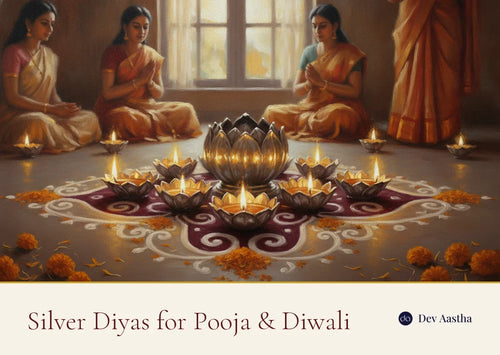
Light is the simplest of the three. A diya lit at dusk in the north-east, every day, is the oldest and least expensive vastu practice there is. Our guide to choosing a silver diya covers the types and sizes.
Natural light and air matter more than any of it. Open the north and east windows in the morning. That is in the spirit of the original texts in a way that a pyramid on a shelf is not.
Does the material matter? Silver, copper, brass and resin
Traditional practice does assign meanings to materials, and the short version is that silver and copper are associated with the water and north-east zones, brass and gold tones with fire and the south-east, and stone or wood with the earth zones in the south and west.
That is the tradition. The practical reality in an Indian home is usually about cost, weight and what survives a decade of dusting.
Silver carries the strongest associations for puja objects, which is why kalash, diya, shankh and small murtis are so often silver or silver-finished. It reads as cool, lunar and north-east, and it photographs beautifully against a wooden mandir.
Solid silver at any useful size is simply out of reach for most households, and that is the gap pure silver plating fills. A plated piece gives the same lustre on a shelf without the cost of solid silver, and it holds detail that cast brass tends to lose.
Being precise about what you are buying is worth a paragraph, because the listings rarely are. Every Dev Aastha piece is 999 silver plating over a resin core, hand-finished. It is not solid silver and it is not hallmarked, and anyone telling you a 6-inch idol at four thousand rupees is solid silver is not telling you the truth.

The Kamdhenu is a good example of why craftsmanship matters more than mass here. The piece only works if the calf reads clearly against the cow, and that is detail work. A silver-plated Kamdhenu cow with calf at 2.5 inches suits a desk or a north shelf; the larger sizes suit a console.
The rest of the material picture, briefly:
- Copper - water vessels, kalash, yantra plates. North and north-east.
- Brass - diyas, bells, larger temple-style murtis. Warm, fire-toned, needs regular polishing.
- Stone and marble - weight, permanence, earth zones. Heavy enough to need a fixed home.
- Wood - mandirs, chowkis, frames. Neutral and usable almost anywhere.
- Crystal and glass - a modern addition with no classical basis. Pleasant, not traditional.
- Resin with plating - the practical middle ground for detailed figures at household prices.
What not to keep, and the items that quietly backfire
The avoid list is shorter than the buy list and matters more, because a wrongly kept object undoes the effect of several correctly kept ones. Most of these are things people already own without having chosen them.
The clear avoids, in rough order of how often they show up in Indian homes:
- Broken, chipped or cracked idols. Retire them properly rather than leaving them on the shelf.
- Stopped or broken clocks. Fix them or take them down. A clock showing the wrong time is the most common one.
- Dead plants and dried flowers, including the decorative dried arrangements sold for exactly this purpose.
- Stagnant water in a fountain, a vase or an unused vessel.
- Nataraja idols at home. The dancing Shiva is a temple form in most traditions, associated with dissolution rather than household calm.
- Images of wild predators, war scenes, weeping figures or sinking ships.
- Mirrors facing the bed or the main door.
- Clutter and junk in the north-east corner. This corner is meant to be the lightest in the house and is usually where the shoe rack ends up.
- Multiple idols of the same deity in one mandir.
- Shoes, brooms or bins near the mandir, or stored under it.
There is also a quieter failure mode, which is buying twenty objects and giving none of them a proper place. A living room holding a pyramid, three yantras, a laughing Buddha, two tortoises and a wind chime is not a well-aligned room. It is a shop counter.
Specific deity forms have specific household rules that are easy to get wrong. The Shivling at home rules and which Shiva form to keep are the two we get asked about most.
If you suspect a genuine structural problem rather than an object problem, vastu dosh: signs, real causes and remedies that work separates the fixable from the folklore.
Buying in order: what to get first
Four objects cover most of what the tradition actually asks for: a diya, a kalash, one deity murti for the mandir, and one living plant. Everything after that is refinement rather than foundation.
Shopping in order matters because the lists online are flat. Twenty-five items presented as equals leaves you buying the decorative ones and skipping the daily ones.
A sensible sequence, with rough Indian price bands:
- First, under ₹2,000. A diya you will light daily, a tulsi or money plant, and a small kalash. The diya is the one object with unbroken daily use behind it.
- Next, ₹2,000 to ₹5,000. One good deity murti for the mandir, properly sized to the shelf, plus a chowki or raised base so it is not sitting on the floor.
- Then, ₹5,000 to ₹10,000. The zone pieces: a tortoise for the north, an elephant pair for the west, a horse image for the south wall. Add one at a time, not as a set.
- Above ₹10,000. A larger centrepiece murti, a full mandir unit, or a statement piece for a console. This is decor spending with a vastu rationale, and that is a fine thing to be honest about.
Two notes on what we do not sell, so you know where to look. Mandir cabinets are furniture and come from furniture retailers. Yantras, pyramids and gemstone products sit outside our range too, and genuine yantra work is worth buying from a specialist rather than a decor shop.
Gifting changes the sequence a little. For a housewarming or griha pravesh, people usually skip straight to the murti or the kalash, and vastu shanti gift ideas covers what hosts and guests each give.
Rented flats, small homes and sensible compromises
Vastu items work in a rented flat exactly as they do in an owned one, because objects and placement are the layer you can change without touching the structure. That is the honest answer to the question we get asked most.
Structural vastu is the part you cannot fix in a rental. The direction the building faces, where the toilet sits, where the kitchen was plumbed. None of that is yours to move, and worrying about it is wasted energy.
What you can do in any flat:
- Find true north once with a compass app, and mark the zones mentally. Most people never do this and guess wrong.
- Clear the centre of the home. Free, immediate, and the rule with the most consensus behind it.
- Move the heavy things south and west - the almirah, the bookshelf, the sofa you sit in most.
- Keep the north-east light. If the shoe rack is there, move it. This is the highest-value ten minutes you will spend.
- Use a cabinet mandir with doors if the only space is in a bedroom.
- Light a diya in the north-east daily, whatever the layout.
In a 1BHK or a studio, zone thinking still applies, just at room scale rather than home scale. Treat the main room as its own grid: heavy to the south-west of that room, mandir and light to its north-east.
One thing not to do is drill, break or rearrange plumbing in a rented home on vastu advice. No classical text asks for that, and no landlord will thank you.
For the layer below objects, vastu for house facing direction explains what each facing actually implies before you sign a lease.
Care and upkeep: the step everyone skips
In vastu, an object that is dirty, broken or neglected is treated as worse than no object at all, which makes upkeep part of the practice rather than housekeeping. Almost no buying guide mentions this.
The weekly routine is short. Dust the mandir and the display pieces, change the water in any bowl or fountain, remove spent flowers, and check that nothing has chipped.
Silver and silver-plated pieces need a specific, gentle approach:
- Wipe with a soft dry cloth. That is the whole routine most weeks.
- Never use metal polish, abrasive paste or a scrubber on a plated finish. Polish is designed to remove a layer, and on plating there is no spare layer.
- Keep pieces out of direct ghee and camphor smoke. Soot dulls detail faster than age does.
- Keep them away from standing water and from bathroom humidity.
- Store in the cloth pouch or box during long trips, rather than leaving them exposed.
Brass wants the opposite treatment and needs periodic polishing to stay bright. Wooden mandirs want a dry cloth and no wax near the idols. Crystal just needs washing.
Plants need the most honest assessment of all. If a plant in the north-east is dying every few months, the corner has no light and the right answer is a different plant, not a replacement of the same one.
The complete vastu items for home checklist
Here is the full vastu items list in one table, by zone, with the honest origin of each item marked. Print it, walk the house once, and fix the placements you already have before buying anything new.
| Item | Where it goes | Origin |
|---|---|---|
| Diya or oil lamp | North-east, mandir, lit daily | Indian |
| Kalash | North or north-east | Indian |
| Deity murti | Mandir, north-east, facing west or east | Indian |
| Shankh | Mandir, on a stand, open side up | Indian |
| Swastik | Near the mandir or threshold | Indian |
| Tortoise / kachua | North, facing into the room | Indian (Kurma) |
| Kamdhenu cow | North, or a work desk | Indian |
| Elephant pair | West, or flanking a desk | Indian |
| Horse image or statue | South wall, solid, not facing a door | Indian |
| Shri Yantra | Mandir or north-east, raised | Indian (tantric) |
| Tulsi plant | North, north-east or east, raised, outdoors | Indian |
| Money plant or bamboo | North or east | Mixed |
| Water fountain or bowl | North or north-east only, water changed | Mixed |
| Mirror | North or east wall, never facing the bed | Mixed |
| Laughing Buddha | Living room, diagonal to the entrance | Chinese feng shui |
| Arowana fish or aquarium | North or north-east living room | Chinese feng shui |
| Wind chimes | North-west, metal ones | Chinese feng shui |
| Three-legged frog, horseshoe | Near the entrance, facing in | Chinese feng shui |
| Vastu pyramid, crystals, salt lamp | North-east, commonly | Modern addition |
| The centre of your home | Keep it empty | Classical, non-negotiable |
Read down the origin column once. If more than half of what you own sits in the feng shui or modern rows, you have been shopping from the wrong list, and the fix is free: move four things and light a lamp.
Frequently asked questions
घर के लिए सबसे ज़रूरी वास्तु आइटम कौन से हैं?
चार चीज़ें सबसे ज़रूरी हैं: रोज़ जलने वाला एक दीया, एक कलश, मंदिर के लिए एक मूर्ति, और एक हरा पौधा।
इन्हें सही दिशा में रखना उतना ही ज़रूरी है जितना इन्हें खरीदना। दीया और मूर्ति ईशान कोण यानी उत्तर-पूर्व में, कलश उत्तर में, और तुलसी का पौधा उत्तर या पूर्व में रखें।
घर का मध्य भाग यानी ब्रह्मस्थान हमेशा खाली रखें। यही एक नियम है जिस पर सभी वास्तु परंपराएँ सहमत हैं।
Which vastu items are best for money and wealth at home?
The north is Kubera's direction, so wealth-related objects belong there: a kalash, a tortoise on a shallow dish of water, a Kamdhenu cow, a cash box, or simply green decor and a healthy plant. Keep that corner clean and uncluttered, because a crowded north works against the intent. A diya lit in the north-east every evening is the traditional daily practice that accompanies all of it.
Is the laughing Buddha a vastu item?
No, it is a feng shui object. The figure is Budai, a Chinese Zen monk from the early 10th century, and he is not a deity in Hinduism or a form of the Buddha worshipped in Indian tradition.
Indian homes have adopted it widely and many vastu consultants now recommend it, so keeping one is a personal choice rather than an error. Just do not expect a classical text to back it up, and think twice before gifting one to a traditional household.
Where should I keep a tortoise in the house as per vastu?
North, facing into the room rather than towards a door or a window. The traditional arrangement sets it on a shallow dish or plate of water, which is changed rather than topped up. Metal and silver-finished tortoises are the usual choice for indoors. The symbolism comes from Kurma, the tortoise form Vishnu took to steady the mountain during the churning of the ocean, so steadiness and slow accumulation are the idea.
Can I keep vastu items in a rented flat?
Yes. Objects and placement are entirely under your control, and that is the layer most vastu advice for homes is actually about. The structural issues in a rental, such as which way the building faces or where the bathroom was plumbed, are not yours to fix.
Find north with a compass app, clear the centre of the home, move heavy furniture south-west, keep the north-east light, and light a lamp daily.
What should not be kept at home as per vastu?
Broken or chipped idols, stopped clocks, dead plants and dried flowers, stagnant water, mirrors facing the bed, and images of violence, predators or decay. Nataraja idols are generally treated as a temple form rather than a household one. Clutter in the north-east corner is the most common real-world problem, usually because the shoe rack ended up there.
How many vastu items should a home have?
Fewer than most lists suggest. Four well-placed objects do more than twenty crowded ones, and a room holding a pyramid, three yantras, two tortoises and a wind chime reads as clutter rather than intent. Start with a diya, a kalash, one murti and one plant. Add zone pieces one at a time, and only where you have a clear place for each.
Do vastu items need to be made of silver?
No. Tradition associates silver and copper with the water-governed north and north-east, and brass with the fire-governed south-east, but material is a preference rather than a requirement. Silver is popular for puja pieces because of its lustre and its association with coolness and calm. Solid silver is out of reach at most useful sizes, which is why pure silver plating over a lighter core is the common middle path for detailed figures.
Which direction should the pooja room face?
The north-east, with the idols facing west or east so that you face east or north while praying. Keep the mandir off the floor on a chowki or raised base, avoid sharing a wall with a bathroom, and do not place it under a staircase or store anything beneath it. In a small flat where the only space is a bedroom, use a cabinet mandir with doors that close at night.
Explore more
Related guides: Vastu items for your home entrance and main door · How to set up a pooja room at home · Vastu dosh: signs, real causes and remedies · Kamdhenu cow vastu: direction and placement · What is the Shri Yantra?
Shop the collection: Positive energy items for home · Silver-plated home decor
Featured pieces: Elephant Pair Showpiece, Silver-Plated · Kuber Kalash Khazana, Silver-Plated
About the author: Sneha covers divine home decor for Dev Aastha, how to style spiritual pieces so they feel at home in a modern Indian house. Her guides blend design sense with respect for what each piece means.
Sources: the list of surviving classical vastu treatises (Mayamata, Manasara, Samarangana Sutradhara, Rajavallabha, Vishvakarmaprakasha, Aparajitaprccha) and their approximate dating follow standard scholarly summaries of vastu shastra. The Budai attribution for the laughing Buddha and the Chinese origin of the arowana, wind chime and money frog symbols follow standard feng shui references.
Placement conventions vary between regions, schools of vastu and individual families, and are given here as they are most commonly kept. Vastu guidance is traditional practice and is not a substitute for professional advice on construction or renovation.
Keep reading
More from the journal

Discussion
No comments yet
Share your thoughts or ask a question below.

