Understanding God Mahadev: The Destroyer, Transformer, and Yogi

The god Mahadev is one of the most loved and most misunderstood deities in Hinduism. We call him Mahadev, which simply means "the Great God", and he is the same deity most people know as Lord Shiva. He is famous as the Destroyer, yet that one word hardly explains him.
Mahadev is the calm yogi seated on a snow peak and the wild dancer whose rhythm holds up the universe. He is a loving husband and father, and the silent ascetic smeared with ash. To understand him is to hold all of these at once.
This guide explains the god Mahadev in plain language. You will learn who he really is, why he is called the Destroyer, what his many symbols mean, the great legends behind him, and how devotees worship him at home today.
Key takeaways
- Mahadev means "the Great God" and is another name for Lord Shiva, one of the three supreme deities of Hinduism.
- As the Destroyer, he dissolves the old to make room for the new, which is renewal rather than harm.
- He is the Adiyogi, the first yogi, and the source of meditation and inner transformation.
- Every symbol on him has meaning, from the third eye and crescent moon to the trishul and the blue throat of Neelkanth.
- Devotees worship him with "Om Namah Shivaya", Monday fasts and Maha Shivratri, and many keep a Shiva idol or lingam at home.
In this guide: Who is god Mahadev? · Why the Destroyer? · The first yogi · His symbols explained · The great legends · His divine family · How devotees worship him · Bringing Mahadev home · FAQ
Who Is God Mahadev?
God Mahadev is Lord Shiva, worshipped as the Supreme Being in the Shaivite tradition of Hinduism. The word Mahadev joins "maha" (great) and "dev" (god), so it literally means the Great God. Many devotees simply call him Shiva Mahadev out of love and respect.
He is one of the Trimurti, the three great powers behind the universe. Brahma creates, Vishnu preserves, and Shiva completes the cycle by dissolving what has run its course.
Mahadev is also known by a long list of names, and each one tells you something about him:
- Shankara and Shambhu: the one who gives joy and well-being.
- Hara: the remover, who takes away sin and sorrow.
- Mahakala: the lord of time and its endings.
- Pashupati: the lord of all living creatures.
- Rudra: his fierce, storm-like aspect from the ancient Vedas.
So when people ask about the god of Shiva worship, the answer is that Shiva himself is that god. He is not below any other deity in this tradition. For his devotees, he is the formless reality behind everything.
To really know him, we have to start with the title that confuses people most.
Why Is Mahadev Called the Destroyer?
Mahadev is called the Destroyer because he dissolves the universe at the end of each great cycle so that creation can begin fresh. This is not cruelty. It is the natural close of a cycle, like night making way for a new dawn.
Think of how a field is cleared after a harvest so the next crop can grow. Shiva's role is that clearing on a cosmic scale. Without an ending, there can be no new beginning.
The same idea works inside us. Devotees pray to Mahadev to destroy their ego, fear and bad habits. Here, destruction means letting go of what holds you back so you can grow.
Nataraja: the cosmic dancer
This balance is captured in his form as Nataraja, the Lord of Dance. In this image Shiva dances inside a ring of fire, and his steps keep the rhythm of creation and dissolution in motion.
One hand holds a small drum that beats out the sound of creation. Another holds a flame, the symbol of dissolution. His raised foot offers release, while a foot pressing down on a tiny figure shows ignorance being subdued. The whole universe, in one graceful pose.
Mahadev as the Adiyogi, the First Yogi
Mahadev is honoured as the Adiyogi, which means the very first yogi. Tradition holds that he gave the science of yoga and meditation to humanity, making him the source of every later teacher.
This is the side of him people often miss. The Destroyer is also the still, silent meditator seated on Mount Kailasa, eyes half closed, lost in deep peace.
As the Adiyogi, he is the great transformer. He shows that real change does not come from the outside. It comes from turning inward, calming the mind, and letting go of what no longer serves you.
This is why so many people drawn to yoga and meditation feel close to him. He is proof that immense power and deep stillness can live in the same being. His example invites you to find that quiet strength in yourself.
That blend of power and calm shows up again in the symbols he carries.
The Symbols of Mahadev, Explained
Almost everything on the god Mahadev is a symbol with a deeper meaning. Once you learn to read them, every image of Shiva becomes a short lesson in how to live.

Here is what the main symbols stand for:
- The third eye: the eye of inner wisdom that sees beyond illusion and can burn away ignorance.
- The crescent moon: mastery over time and a mind that stays calm through every phase.
- The river Ganga: Shiva holds the sacred river in his hair, a sign of purity and the gentle flow of knowledge.
- The trishul: his three-pointed spear, standing for creation, preservation and dissolution.
- The damaru: the small drum whose beat is said to be the first sound of the universe.
- Vasuki the snake: the serpent around his neck shows his mastery over fear, desire and death itself.
- The tiger skin: on which he sits, a sign of fearlessness and victory over animal instinct.
- The ash (vibhuti): smeared on his body as a reminder that everything in the world is temporary.
The blue throat deserves its own story, which brings us to his most famous legends.
The Great Legends of Mahadev Shiva
The stories of Mahadev Shiva are some of the most powerful in Hindu tradition. They are not just tales. Each one carries a lesson about sacrifice, devotion and balance.
Neelkanth: the god who drank poison
During the churning of the cosmic ocean, the Samudra Manthan, a deadly poison called Halahala rose up and threatened all creation. No god or demon dared touch it.
Shiva stepped forward and drank the poison to save the universe. Goddess Parvati held his throat so it could go no further, and the poison stayed there, turning his throat blue. This is why he is lovingly called Neelkanth, the blue-throated one. It is the perfect image of his compassion and self-sacrifice.
The descent of the Ganga
When the mighty river Ganga came down from the heavens, her force was strong enough to shatter the earth. Shiva calmly caught her in his matted locks and released her in gentle streams.
By taming her flow, he let the sacred river bless the land without destroying it. The story shows how he turns overwhelming power into something nourishing and kind.
Burning desire to ash
In another well-known tale, Kamadeva, the god of desire, disturbed Shiva's deep meditation. With a single glance from his third eye, Shiva reduced him to ash. The story is a reminder that true focus cannot be ruled by craving. These legends all point to a deity who is fierce yet deeply loving.
The Divine Family of Shiva
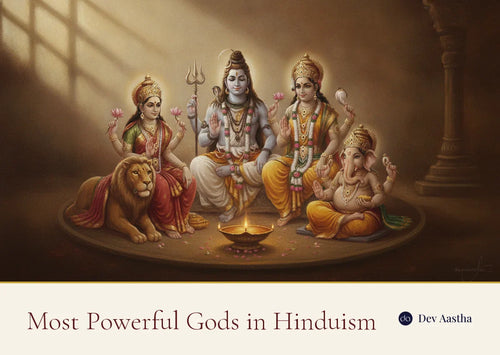
Mahadev is not only an ascetic on a mountain. He is also a devoted family man, and the Shiv Parivar, his divine family, is itself a picture of harmony.
His consort is Goddess Parvati, who is Shakti, the divine feminine energy. Their union shows a rare balance, the meditating yogi joined with the loving force of life. In his form as Ardhanarishvara, Shiva and Parvati share one body, half male and half female, teaching that the two energies are equal and inseparable.
Their two sons are widely worshipped in their own right:
- Lord Ganesha: the elephant-headed remover of obstacles, prayed to before any new beginning.
- Lord Kartikeya: also called Murugan or Skanda, the brave commander of the gods' armies.
Together they form the Shiv Parivar, a model of love, protection and unity that many families keep close in their homes. That sense of closeness is why so many devotees invite Mahadev into daily life.
How Devotees Worship Mahadev
Devotees worship the god Mahadev with simple, heartfelt practice rather than grand ritual. Sincerity matters far more than show, which is part of why he is so loved across India.
People often search for Mahadev god images, mantras and fasting rules because daily devotion to him is so common. These are the most popular ways to connect with him:
- Om Namah Shivaya: his five-syllable mantra, chanted softly to steady the mind. It simply means "I bow to Shiva".
- The Mahamrityunjaya Mantra: a powerful verse recited for health, healing and protection.
- Monday vrat: Monday is Shiva's day, and many keep a light fast and offer prayers then.
- Abhishekam: bathing the Shiv Lingam with water, milk and honey, often with a bilva (bel) leaf offered on top.
Maha Shivratri, the great night of Shiva
The biggest festival for him is Maha Shivratri, the "great night of Shiva", usually in February or March. Devotees stay awake through the night, chant his name, and offer prayers at temples.
It is seen as the night when Shiva's energy is closest to earth. Many believe sincere worship on this night brings deep blessings and a fresh start.
The Shiv Lingam
Shiva is often worshipped not as a figure but as the Shiv Lingam, a smooth, rounded form. The lingam represents his formless, infinite nature, the truth that the divine has no single shape. It reminds devotees that he is present everywhere, not just in one image.
Bringing Mahadev Into Your Home
You can welcome the god Mahadev into your home with a small, well-kept shrine and a sincere daily habit. A grand setup is never needed. A clean space and steady devotion matter most.
According to Vastu, a meditating Shiva idol is best placed in the north or east part of the home, facing west or south so the deity looks toward you as you pray. Keep the spot tidy, and avoid placing it inside a bedroom or bathroom wall.

Choosing an idol, honestly
If you wish to keep a murti, pick a form that speaks to you. The meditating Mahadev brings calm, Nataraja brings energy, and a simple lingam suits a minimal shrine.
A word of honesty on material helps. A solid silver idol is sold by weight and runs very costly, often far more than a home shrine needs. Our pieces, such as this silver-plated Lord Shiva idol, are pure silver plating over a sculpted resin core, hand-finished for fine detail. You get the bright, sacred glow of silver without the price of solid metal, and we make no solid-silver claims.
Match the size to your altar, from a small desk piece or a Shiva idol for the car dashboard to a larger murti for a dedicated mandir. You can browse more forms in our god idols collection as you decide. Whatever you choose, the idol is a focus for your faith, never a measure of it.
The Shiva and Shakti union at the heart of Mahadev is also the core idea behind the Shri Yantra, the sacred diagram where the two energies meet as one.
The seven chakras come from the same yogic tradition that honours Shiva as the first yogi. To explore them through a popular decor piece, see our guide to the 7 chakra crystal tree and what each stone means.
Many Shiva shrines keep a kalash for daily worship. If you are setting one up, our guide to the kalash nariyal and its significance in pooja walks through every step.
Frequently Asked Questions
Who is god Mahadev?
God Mahadev is another name for Lord Shiva, one of the three principal deities of Hinduism. The word Mahadev means "the Great God". He is worshipped as the Supreme Being who destroys the old to allow new creation, and as the first yogi and source of meditation.
Is Mahadev the same as Shiva?
Yes. Mahadev and Shiva are the same deity. Mahadev is a title meaning "Great God" that devotees use out of love and reverence. He is also known by names like Shankara, Hara, Mahakala, Pashupati and Rudra, each describing a different aspect of him.
Who is the god of Shiva?
In the Shaivite tradition, Shiva is not below any other god. He himself is the Supreme Being, the formless reality behind all creation. So there is no separate "god of Shiva". Devotees regard Mahadev as the highest truth and the source of everything.
Why is Shiva blue-throated (Neelkanth)?
During the churning of the cosmic ocean, a deadly poison rose up that could destroy creation. Shiva drank it to save the universe, and Parvati held his throat so it stayed there, turning his throat blue. This is why he is called Neelkanth, the blue-throated one.
Can a Shiva idol be kept at home for worship?
Yes, keeping a Shiva idol at home is a common and respected practice. Place it in a clean spot in the north or east, ideally facing west or south, and avoid bedrooms or bathroom walls. A meditating form is widely preferred for its calm, peaceful energy.
Mahadev ki puja kaise karein?
Mahadev ki puja saral aur saccha mann se ki jaati hai. Roz "Om Namah Shivaya" ka jaap karein, Somvar ka vrat rakhein, aur Shiv Lingam par jal, doodh aur bel patra arpit karein. Maha Shivratri par raat bhar jaagran aur bhakti se Mahadev god ki vishesh kripa maani jaati hai.
Explore more
Related guides: The 10 avatars of Vishnu (Dashavatar) · The unmatched power of Lord Hanuman · Your guide to a Hanuman ji idol for home
Shop the collections: Devotional idols · Peace & harmony

Written by Arun Mehta · Updated June 2026
Arun covers Hindu traditions, vastu and festivals for Dev Aastha, translating time-honoured practices into clear, practical guidance for modern Indian homes. His writing draws on scriptural sources and the lived traditions of devout households.
Arun covers Hindu traditions, vastu and festivals for Dev Aastha, translating time-honoured practices into clear, practical guidance for modern Indian homes. His writing draws on scriptural sources and the lived traditions of devout households.
Keep reading
More from the journal